
Peptides for Gut Health: The 5 Best for Inflammation


Which Peptides for Gut Health Work Best?
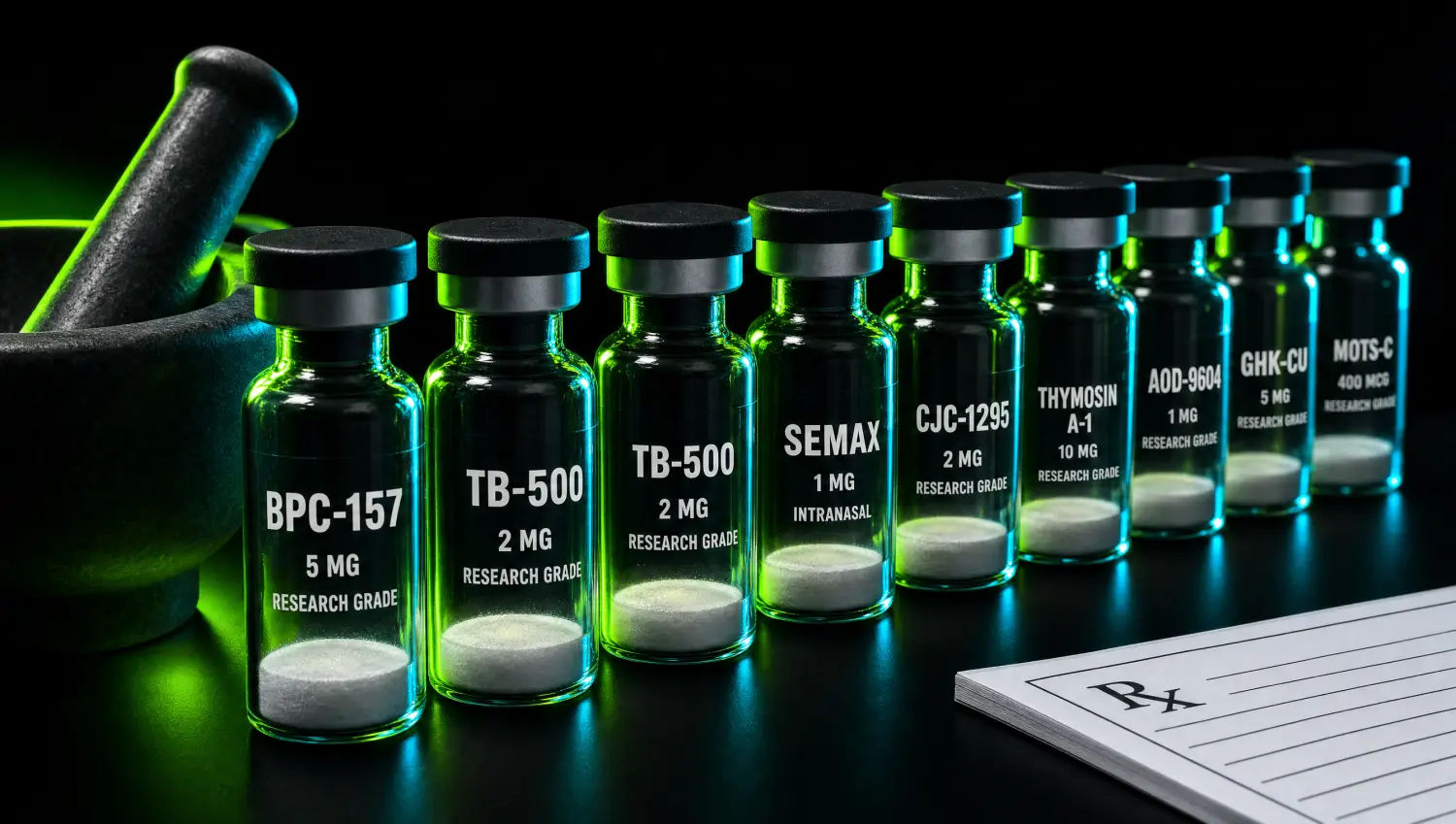
The best peptides for gut health are BPC-157, TB-500, GHK-Cu, KPV and MOTS-c. BPC-157 leads on evidence. It is 15 amino acids long, and human IBD trials found no toxicity. KPV shuts down gut inflammation at the source. TB-500 and GHK-Cu repair tissue. MOTS-c works on metabolism. None of the 5 is FDA approved.
Each one works a different way. Here is the short version. The detail follows below.
| Peptide | What it acts on | Strength of evidence |
|---|---|---|
| BPC-157 | Gut lining repair, blood supply, NSAID damage | Strongest. Animal models plus early human IBD trials |
| TB-500 | Systemic cell migration and tissue repair | Good for wounds. No gut trial data |
| GHK-Cu | Collagen synthesis, oxidative stress | Skin and wound research. Gut evidence is extrapolated |
| KPV | Inflammatory signalling inside the gut wall | Animal and cell models only |
| MOTS-c | Metabolism and insulin sensitivity | Mouse models and mechanism work |
Gut trouble is often the quiet problem under everything else. Poor recovery. Flat energy. Brain fog that never quite lifts. You see it in people who train hard, travel a lot, or push back into shape after a long lay-off. Disclosure: this article links to a trusted source for one of these compounds and that link supports the channel.
What Peptides Are Good for Gut Health? Start With BPC-157
BPC-157 is a 15-amino-acid peptide. Your body makes it already, in gastric juice.
It speeds healing of the gut lining. It lowers pro-inflammatory cytokines, the chemical messengers that keep swelling going. It has been through human trials for bowel disease with no safety flags. It is the most studied gut peptide of the group.
The mechanism runs through nitric oxide. The peptide works with NO signals to guard the endothelium, the thin lining inside blood vessels. It helps new vessels form. It also fights off the harm NSAIDs do to the gut lining. That shows up across rat models of short-bowel syndrome. It shows up in failed anastomosis too, which is a surgical join between two parts of the bowel. Lojo 2016 found the peptide rescued short-bowel rats. It helped those joins heal where standard care alone did not. A broad review confirms it cuts TNF-alpha and IL-6. Those are the same cytokines raised in long-running gut trouble. The same review reports what the literature calls organoprotection across the whole GI tract (Sikiric).
Fistula and colitis models tell a similar story. In rats, the peptide sped up healing of colocutaneous fistulas through that same nitric oxide route. Those rats were tested at PL14736 trial doses (Klicek). Separate work on surgical joins showed less swelling and fewer granulocytes from day one. Collagen and reticulin rose by days four to five (Vuksic). New vessel support through VEGF-like signals is the thread running through all of it (Seiwerth). That is why the compound keeps turning up in gut, tendon and skin work at once.
None of this is human clinical proof at scale. The bowel disease trials named in this literature reported no toxicity. No lethal dose was reached. That is a meaningfully strong safety signal. But most of the mechanism evidence is still preclinical. For how research protocols dose and give it, see the BPC-157 dosing and administration protocol. For the gut picture on its own, see BPC-157 for gut health.
What Does TB-500 Do for Gut Inflammation?
TB-500 is a synthetic fragment of thymosin beta-4. It works across the whole body, not at one injury site. It lowers pro-inflammatory cytokines. It also drives cell movement, new blood vessel growth and collagen laid down in tissue. The gut wall is part of that. It is better studied for wound healing in general than for the gut.
The active fragment is Ac-LKKTETQ. That fragment binds actin. Actin binding is what moves cells during repair. Ho 2012 described it and confirmed what it does. It promotes new vessel growth, skin cell movement and collagen laid down in tissue. Markers of swelling dropped alongside. Thymosin beta-4, the parent molecule, pulls myoblasts toward hurt muscle. It rises sharply in the early stages of repair (Tokura). It calms mucosal tissue too. Eye wound models show less cell death and faster closure (Sosne).
For the gut, the case here is weaker than the one for BPC-157. There is no gut trial data at all. What exists is strong whole-body repair evidence. It plausibly reaches gut tissue, given the shared cytokine routes. Those routes are TNF-alpha, IL-1beta and IL-6, and they run in both muscle and mucosal injury.
Can GHK-Cu Help Inflamed Tissue Heal?
GHK-Cu is a copper-binding tripeptide. It boosts collagen. It tunes the enzymes that rebuild tissue. It cuts oxidative stress at very low doses. It is best documented in skin research. The gut evidence is mostly carried over from that wound work, not from gut trials.
At concentrations between one and ten nanomolar, it boosts both collagen and glycosaminoglycan, a sugar chain in connective tissue. It also steers the metalloproteinases (TIMP-1 and TIMP-2) that balance tissue breakdown against repair. Pickart 2015 logged faster wound healing across rabbit, rat, mouse and pig models. That included better results in diabetic and ischemic wounds. TNF-alpha fell and collagen output rose. That mix of antioxidant and calming action is why it sits with the gut-repair group. The trials behind it were run on skin and connective tissue, not gut lining.
Why Does KPV Go Straight to Inflamed Gut Tissue?
KPV is a three-amino-acid fragment of alpha-MSH. Its defining feature is delivery.
It shuts off NF-kappaB, a master switch for swelling. It lowers cytokines right inside gut tissue. KPV rides in on the PepT1 transporter. PepT1 is rife in the small bowel. It climbs higher still in inflamed colon tissue. So KPV has a built-in homing mechanism.
That means inflamed gut tissue takes up more KPV than healthy tissue does. Few peptides steer themselves that way. KPV also works upstream of the damage. It blocks NF-kappaB before the cytokine cascade (TNF-alpha, IL-1beta, IL-6) gets going. It does not mop up after the fact. That is why its strongest preclinical signal shows in bowel disease models. Ulcerative colitis and Crohn's-like swelling are the two studied. The signal there is stronger than in general wound work. Human trial data for KPV remains limited. The evidence base is animal and cell-model work, not clinical studies. Treat the mechanism as well characterised. Treat the human outcomes as still unproven. The KPV complete guide goes further into how it works.
How Does MOTS-c Change the Metabolic Picture?
MOTS-c comes from the mitochondria. It lowers markers of swelling through the AMPK route. It also improves insulin sensitivity and glucose handling. It works on the metabolic side of long-running swelling, not on gut tissue. That makes it a different kind of tool from the other four here.
Hard effort switches MOTS-c on naturally. Its output falls with age. That tracks the wider loss of metabolic resilience that comes with getting older. It works through the Folate-AICAR-AMPK route. It breaks the folate-methionine cycle in a way that mirrors some effects of methotrexate, but without the same toxicity (Wan 2023). In mice, it cut pro-inflammatory factors and raised calming ones. Insulin-driven glucose uptake improved at the same time (Zheng). That mix is hard to find in one compound. Separate work confirms exercise itself raises MOTS-c in muscle and blood. That ties training load straight to this calming route (Gao).
Is your gut trouble tangled up with insulin resistance, a sluggish metabolism, or falling training capacity? Then MOTS-c works on a different layer of the problem than BPC-157 or KPV do.
What Are the Best Peptides for Enhancing Intestinal Barrier Function in IBD Patients?
Two of the 5 act on the gut barrier itself.
BPC-157 rebuilds the lining and its blood supply. KPV blocks the signals that keep the barrier leaky. Inflamed colon tissue soaks it up first. Those two carry the bowel disease model evidence. Only BPC-157 has human trial history in that setting.
Read that as mechanism, not as a treatment plan. IBD is a diagnosed disease. None of these compounds is approved to treat it. GHK-Cu and TB-500 support repair more broadly. Neither has gut trial data. Anyone with diagnosed IBD needs a clinician in the loop, not a research peptide bought online.
Is There One Best Peptide for Gut Health and Inflammation?
No single one wins. Research suggests they work through complementary rather than overlapping routes. BPC-157 restores local blood supply and lining integrity. TB-500 supports whole-body cell repair. KPV blocks the signals upstream. GHK-Cu drives collagen rebuild. MOTS-c covers the metabolic backdrop. That is the theory behind combining them. Human safety and efficacy data for stacking several at once is limited.
Anecdotally, users in the recovery space report pairing BPC-157 with TB-500 for injury repair. Some pair KPV with gut-barrier work instead, when the trouble is more digestive than muscular. These are self-reported patterns, not trial outcomes. Read them that way. The KPV and BPC-157 gut stack covers that pairing in detail. Coming back to hard training after a lay-off, the pull is to stack everything at once. Research points to a tighter route. Address the dominant mechanism first, whether that is gut lining, whole-body swelling or metabolic trouble. Add a second compound only once you know how your body answers the first.
How Safe Are the Best Peptides for Inflammation?
None of these 5 peptides carry FDA approval for human use. Research dosing ranges vary widely by compound. BPC-157 sits in a 10 mcg/kg to 10 ng/kg range tested in animal and early clinical work. TB-500 protocols are often run in loading-then-maintenance cycles. Always work with a qualified clinician before making changes to your health protocol.
BPC-157 has the strongest safety signal of the five. It was tested in human bowel disease trials with no reported toxicity and no lethal dose found. Even so, a recent review of the literature and the patents confirms a gap. It still lacks the full human studies needed for approval. Its research-use status is unlikely to change soon (Jozwiak 2025). TB-500, GHK-Cu, KPV and MOTS-c all sit further back on the evidence curve. They have mostly preclinical or cell-model data. None has an equal human trial history. Treat every dosing figure in this article as research context, not a personal protocol.
Where to buy BPC-157
If you're researching this compound, I've linked a trusted source below. It supports the channel.
See the sources that passed →Where Are the Best Resources on Peptides for Gut Health?
Start with the primary literature cited here. Then check who you are buying from.
Peptide quality varies enormously between suppliers. Purity is the single biggest risk in this space, not the compounds. Third-party testing, batch paperwork and a supplier's willingness to share certificates of analysis are the markers worth checking.
We keep a running, vendor-neutral list of checks and good practice on our recommended sources page. It is worth reading before you commit to any supplier for BPC-157 or the others here. If you're researching this compound, I've linked a trusted source below. It supports the channel.
Bibliography
Lojo et al. 2016, PMC5023193. Sikiric et al. 2020, PMID 31158953. Klicek et al. 2008, PMID 18818478. Vuksic et al. 2007, PMID 17713731. Seiwerth et al. 2018, PMID 29998800. Ho et al. 2012, PMID 23084823. Tokura et al. 2011, PMID 20880960. Sosne et al. 2007, PMC2701135. Pickart et al. 2015, PMC4508379. Wan et al. 2023, PMC9854231. Zheng et al. 2023, PMC9905433. Gao et al. 2023, PMC9866798. Jozwiak et al. 2025, PMC11859134.
This content is for educational purposes only. These compounds are intended for research use. Nothing here is medical advice. Always work with a qualified clinician before making changes to your health protocol.
Where to buy BPC-157
If you're researching this compound, I've linked a trusted source below. It supports the channel.
See the sources that passed →Share this article
Frequently Asked Questions
What is BPC-157 and how does it support gut health?
How does TB-500 differ from BPC-157 for gut inflammation?
Can GHK-Cu help with intestinal inflammation?
What makes KPV unique for gut barrier repair?
How does MOTS-c reduce systemic inflammation?
Are these peptides approved by the FDA?
Read Next

Disclaimer: This content is for educational purposes only. These compounds are intended for research use. Nothing here is medical advice. Always work with a qualified clinician before making changes to your health protocol.