
KPV BPC-157 Stack for Gut Healing: Protocol and Dosing

What Is the BPC 157 and KPV Stack for Gut Repair?
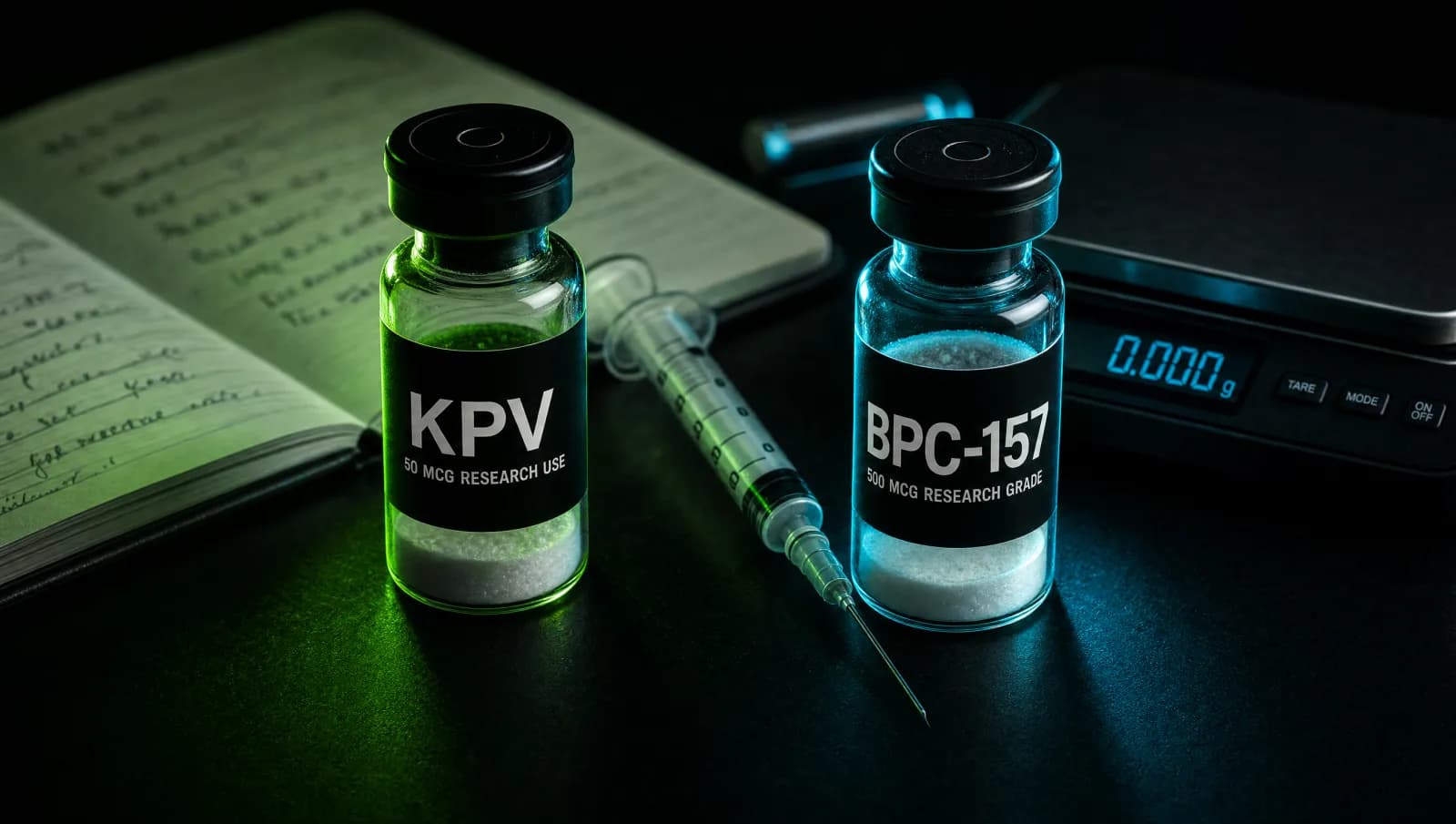
The KPV BPC-157 stack pairs two peptides that fix different parts of the gut. BPC-157 rebuilds blood supply and the lining. KPV shuts down the signals that keep that lining sore. Run together, they hit structural damage and live inflammation at the same time. Either one alone leaves that gap open.
One disclosure first. This page links to a trusted third-party source for research peptides further down. That link supports the channel. It is not a paid placement dressed up as advice.
Neither peptide has been through a large human trial for gut healing. What you read here comes from animal models, cell studies and the protocols the recovery crowd actually runs. Treat it as a frame for research, not a prescription.
This content is for educational purposes only. These compounds are intended for research use. Always work with a qualified clinician before you change your health protocol.
How Does BPC-157 Repair the Gut Lining?
BPC-157 speeds up gut repair in three ways. It raises blood flow to the hurt spot. It guards the mucosal barrier, the slick layer that lines the gut. And it helps the surface cells crawl across the raw patch. That is how a lining closes. The peptide was first drawn from human gastric juice, which is a strange place to find a repair signal. That start is part of why it keeps pulling towards gut tissue in animal work. Our BPC-157 and gut health guide goes deeper on the single-peptide case.
Review data across several animal models reports steady healing of gut fistulas and surgical joins. A fistula is an odd tunnel between two organs. The team behind that work calls the effect steady across very different wounds. (Sikiric P et al., 2020)
Other review work frames BPC-157 as a guard for the gut lining. It defends tissue while that tissue is under stress. It does not just mop up after the harm. No toxic ceiling turned up in the animal work they read. (Sikiric P et al., 2016)
The same body of work points to lower pro-inflammatory cytokines in models of inflammatory bowel disease. Cytokines are the immune system's messages. TNF-alpha and interleukin-6 both drop. The calming side of the immune response gets help. The whole response is not just switched off.
Does BPC-157 raise growth hormone?
No. It does not push your growth hormone up. It makes local tissue more alert. So the GH and IGF-1 you already carry drive a stronger repair where you need it. That is why it reads as a repair tool, not as hormone therapy.
Studies in fibroblasts show BPC-157 raising growth hormone receptor levels. A fibroblast is the cell that builds connective tissue. More peptide raises it, and more time raises it. It climbs as mRNA, the gene's working copy, and as protein. Phosphorylation of JAK2 also improves. That step turns a live receptor into cell growth. (Chang CH et al., 2014)
Later work reads this as tuning, not as flooding. BPC-157 lifts VEGFR2, a docking point for the signal that grows new vessels. It also tunes nitric oxide signals. (Sikiric P et al., 2020) It boosts what you already make.
So the stack is framed around repair at tissue level. Once vessel density and a whole lining are back, there is nothing left to boost. The effect has a natural ceiling. It does not run on unchecked.
How Does KPV Calm Gut Inflammation?
KPV is a piece of alpha-MSH, a natural hormone. It is only three amino acids long. It calms the gut by blocking IL-1beta signals and by damping NF-kappaB. Those two paths keep a sore loop running in colitis-type illness. KPV gets into gut cells through a carrier called PepT1. It does not use a hormone receptor.
Early work assumed KPV rode the same melanocortin receptors as its parent hormone. Later studies overturned that. It is unlikely to act through those receptors at all. It blocks IL-1beta function directly instead. (Getting SJ et al., 2003)
A review credits most of the calming power of alpha-MSH to this tail piece. That is KPV doing the work on its own. (Luger TA and Brzoska T, 2007)
The carrier matters in practice. Landmark work in Gastroenterology showed PepT1 uptake of KPV cutting gut inflammation markers in colitis models. That is why an oral, enteric-coated form is the one most people discuss for gut work. (Dalmasso G et al., 2008)
KPV also kills microbes by itself. It acts on S. aureus and Candida albicans at levels the body reaches on its own. That counts if your gut trouble has dysbiosis as well as inflammation. Dysbiosis means the mix of gut microbes has gone wrong. (Cutuli M et al., 2000)
Can This Stack Ease GLP-1 Gut Side Effects?
On paper, yes. In tested fact, nobody knows.
If a GLP-1 drug is upsetting your gut, the logic is simple. BPC-157 helps the lining heal. KPV calms the response that keeps it sore. Both overlap with the tissue stress these drugs cause. No human trial has tested this pair for that job.
Gut side effects from GLP-1 agonists are common enough to matter. A study of nearly 10,300 people on these drugs found nausea, diarrhoea, vomiting and constipation. Those symptoms drove people to quit in six to ten percent of cases. (Aldhaleei WA et al., 2024) That is a lot of people stopping a drug that was working.
If this is you, talk to whoever manages your prescription first. Dose titration, meal timing and fibre changes are the tools they reach for. Those carry real clinical backing for this exact problem. A peptide stack sits well behind them until the human data catches up.
What Is the KLOW Peptide Stack: BPC-157, TB-500, GHK-Cu, KPV?
Healing runs through four phases.
Blood clots first. Then comes inflammation, then the rebuild, then the tidy-up that makes new tissue strong. BPC-157 and KPV cover inflammation and the early rebuild well. Neither touches the actin-driven cell movement TB-500 supports (actin is the fibre cells crawl on). Neither drives the collagen work GHK-Cu does. That gap is the whole case for the four-peptide version some people call KLOW.
Think of it as a split of labour, not four peptides doing one job.
| Peptide | What it does in the stack | Phase it covers |
|---|---|---|
| BPC-157 | Rebuilds blood supply, tunes growth receptors | Inflammation and rebuild |
| KPV | Quiets the noise so repair signals get heard | Inflammation |
| TB-500 | Helps cells move into the damaged area | Rebuild |
| GHK-Cu | Supports collagen links so new tissue lasts | Tidy-up |
Stack all four and you cover every phase on paper, not just the first two. Whether that holds in a body is a different question. Nobody has answered it.
How Do You Run the KLOW Peptide Stack (GHK-Cu, BPC-157, TB-500, KPV)?
What doses do people actually run?
Protocols for the gut pair usually sit at 250 to 500 mcg of BPC-157 a day. KPV usually sits at 10 to 100 mcg a day. Most people run an 8 to 12 week research window and then take stock. These ranges are what gets discussed, not an agreed clinical standard. Treat them as a start point for your own research.
Oral, enteric-coated KPV is the form most people pick for gut work. The coating carries it through stomach acid to the gut cells, where PepT1 can pick it up. BPC-157 shows up in both shot and oral protocols. The shot is more common when the aim is repair across the whole body, not the gut alone.
What is still unknown?
Here is the honest safety picture. Both peptides look low in toxicity in animal models. No lethal dose has been set for BPC-157 in the work reviewed. Neither has a large human safety trial behind it. Early BPC-157 work in ulcerative colitis reported gains with no published toxicity signals. The samples were small. Much of that work is still unpublished in peer-reviewed form.
KPV has no published human trials at all. That gap grows once you stack. Nobody has studied how BPC-157 and KPV behave together in a human body, let alone all four. The rules have moved too. BPC-157 sourcing rules changed through 2023 to 2026, and KPV moved category in 2026. Check where things stand before you plan anything.
The trade-off with four peptides is complexity. Four unproven pairings mean four times the sourcing risk and four times the doubt about how they interact. If any of this is new to you, start with the two-peptide gut pair. See how you respond before you add TB-500 and GHK-Cu. The wolverine stack covers the BPC-157 and TB-500 pairing on its own.
None of this is a reason to panic. It is a reason to be exact about what you are leaning on. Solid mechanism work. Thin human data. A supplier field that swings wildly in quality. Our sourcing guide covers what to look for in a certificate of analysis before you commit.
Where to buy KPV and BPC-157
If you're researching this compound, I've linked a trusted source below. It supports the channel.
See the sources that passed →References
- Sikiric P et al. Fistulas Healing. Stable Gastric Pentadecapeptide BPC 157 Therapy. Curr Pharm Des, 2020. PubMed
- Sikiric P et al. Brain-gut Axis and Pentadecapeptide BPC 157: Theoretical and Practical Implications. Curr Neuropharmacol, 2016. PubMed
- Getting SJ et al. Dissection of the anti-inflammatory effect of the core and C-terminal (KPV) alpha-melanocyte-stimulating hormone peptides. J Pharmacol Exp Ther, 2003. PubMed
- Luger TA and Brzoska T. alpha-MSH related peptides: a new class of anti-inflammatory and immunomodulating drugs. Ann Rheum Dis, 2007. PubMed
- Dalmasso G et al. PepT1-mediated tripeptide KPV uptake reduces intestinal inflammation. Gastroenterology, 2008. PubMed
- Cutuli M et al. Antimicrobial effects of alpha-MSH peptides. J Leukoc Biol, 2000. PubMed
- Chang CH et al. Pentadecapeptide BPC 157 enhances the growth hormone receptor expression in tendon fibroblasts. Molecules, 2014. PubMed Central
- Aldhaleei WA et al. Glucagon-like Peptide-1 Receptor Agonists Associated Gastrointestinal Adverse Events. Pharmaceuticals (Basel), 2024. PubMed Central
This content is for educational purposes only. These compounds are intended for research use. Nothing here is medical advice. Always work with a qualified clinician before you change your health protocol.
Where to buy KPV and BPC-157
If you're researching this compound, I've linked a trusted source below. It supports the channel.
See the sources that passed →Share this article
Frequently Asked Questions
What is the KPV and BPC-157 gut stack, and why run both?
Does BPC-157 raise growth hormone, or does it just tune receptors?
How does KPV get into gut cells if peptides absorb so poorly?
Can BPC-157 and KPV help with GLP-1 nausea and gut side effects?
What are the four healing phases, and how do peptide stacks cover them?
Is there human evidence for BPC-157 and KPV gut healing claims?
Read Next


Disclaimer: This content is for educational purposes only. These compounds are intended for research use. Nothing here is medical advice. Always work with a qualified clinician before making changes to your health protocol.