
BPC-157 Prescription in 2026: Why No Pharmacy May Fill One

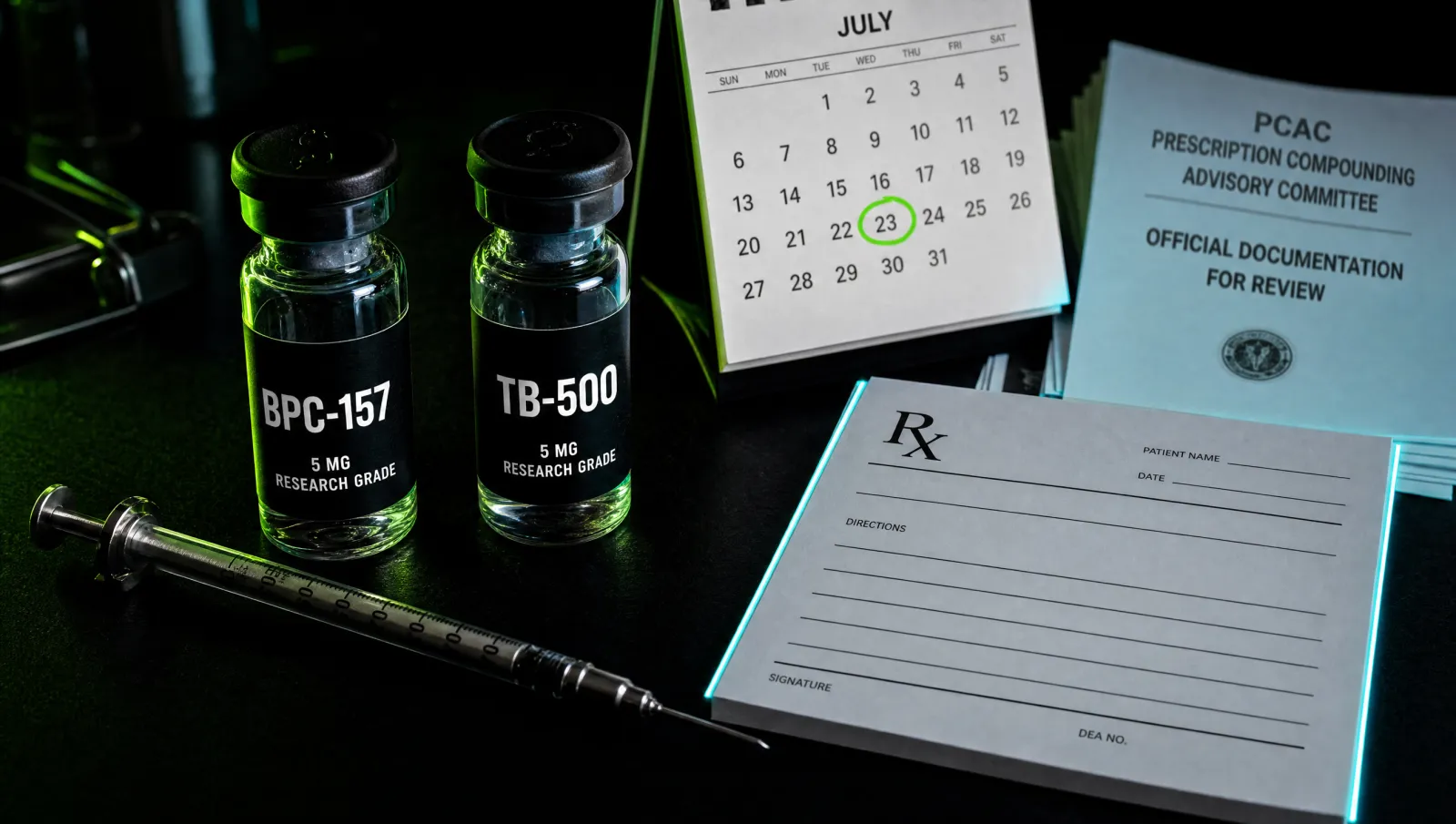
Do You Need a Prescription for BPC-157 in 2026?
A BPC-157 prescription cannot be lawfully filled in the US as of October 2026. No US pharmacy may compound BPC-157 or TB-500 for human patients under federal law today. To compound is to make up a drug to order. The FDA advisory vote in July did not change that.
Neither peptide has a USP monograph (a published quality standard) or a place in an FDA-approved drug. Those are two of the three ways the law lets a pharmacy use an ingredient. The third is a final FDA rule, and none has even been proposed. That answer is blunt, so this page shows the work behind it. It covers the rule, what the July meeting did and did not do, and what the research shows. It also sets out what each route can and cannot offer.
The rule comes first, because it is older than the vote.
Why Can't a Pharmacy Fill a BPC-157 Prescription in the USA?
The block is section 503A of federal drug law, the part that covers pharmacy compounding.
A 503A pharmacy makes up a drug for a named patient, on a valid script. Its bulk ingredient must qualify in one of three ways. The first is being part of a drug FDA has approved. The second is a USP or NF monograph, which is a published quality standard. The third is a place on the 503A bulks list, which FDA sets by rule (21 U.S.C. 353a).
Both peptides fail all three tests today. FDA's 2026 briefings found no USP or NF standard for either one (FDA BPC-157 briefing; FDA TB-500 briefing). They also found that neither is part of a drug FDA has approved. And the bulks list itself, 21 CFR 216.23, names neither.
None of this started in July. Before the vote, FDA had placed BPC-157 and TB-500 in Category 2. TB-500 is a fragment of thymosin beta-4, a natural protein. Category 2 held nominated substances that FDA said may present significant safety risks. The nominations were later withdrawn. FDA's safety-risk page now lists BPC-157 and TB-500 as withdrawn nominations that were once in Category 2. Our full report on the July FDA peptide vote sets out the record in detail.
So a clinic that says it can fill a BPC-157 or TB-500 script today is claiming more than the federal record allows. Our explainer on the FDA's peptide rules covers what each step does and does not do.
Which leaves the obvious question. If the rule is that old, what did the July vote actually achieve?
What Is the BPC-157 Prescription Status After the July FDA Vote?
The BPC-157 prescription status is unchanged. FDA's compounding advisory panel of outside experts met on 23 and 24 July 2026. It voted to back six of seven peptides for the 503A bulks list, BPC-157 and TB-500 among them (NCPA). The votes are recommendations and are not binding on FDA.
Three details from FDA's written record matter more than the vote.
First, FDA's own briefings went the other way. For both peptides, FDA wrote that it believes its tests "weigh against" putting them on the list.
Second, the nominations had been withdrawn before the meeting. FDA's briefings say it evaluated BPC-157 and TB-500 "at its discretion" anyway. It looked at two forms of each, the free base (the bare peptide) and the acetate (a salt form).
Third, FDA found none of those forms "well characterized" in physical and chemical terms. It said the data to prove what each one is, how pure it is and its quality were lacking or not good enough. A vote does not supply that lab data.
Then there is the process. FDA adds substances to the bulks list through a formal rule process. That means a proposed rule, a time for public comment and then a final rule. NCPA, a pharmacists' trade group, reported that pharmacies may not compound these peptides until the final rule is in place. It added that the Health Secretary, Robert F. Kennedy Jr., must still sign off on any addition.
We searched the Federal Register, the US journal of new rules, on 5 October 2026. It held no proposed rule naming BPC-157. Its only 2026 entry was FDA's April notice of the July meeting. FDA's 503A category list, updated in May, says FDA intends to consult the panel about GHK-Cu before the end of February 2027.
So the legal position has not moved. The science is the part that is still unfinished.
Is There Human Evidence Behind a BPC-157 Peptide Prescription?
Very little human evidence exists for either peptide. Most of the work is in cells and animals.
A 2026 review for bone, joint and sports doctors found BPC-157 may have benefits for tendon and muscle repair. It said these findings are largely unvalidated in human trials. The one human case series it found, of knee shots, had serious flaws and no control group (Mayfield 2026).
Lab work on rodent (rat) tendon cells found BPC-157 raised growth hormone receptor levels. Adding growth hormone then increased cell growth (Chang 2014). A review by a team in Zagreb, Croatia, says BPC-157 counters upsets in several brain signal systems. It also says BPC-157 acts on receptors for growth hormone and for VEGF, a signal that grows new blood vessels (Sikiric 2024). FDA notes that BPC-157 was first made at the University of Zagreb in the early 1990s. FDA's search found five published clinical studies of BPC-157.
TB-500 has even less human data. It is a seven amino acid fragment of thymosin beta-4, a larger natural protein. A 2026 scoping review, which maps what research exists, took in 80 studies. Most tested thymosin beta-4, not TB-500. Just one looked at TB-500 itself (McGuire 2026). FDA found no clinical studies or human exposure data for TB-500 by any route.
Thymosin beta-4 itself has been studied in the eye. A 2007 review said it helps wounds on the front of the eye heal and calms inflammation (Sosne 2007). Most of the human data in the 2026 scoping review was on the eye and on skin wounds. The sports review found no human bone and joint data for thymosin beta-4 or TB-500. Chemists have also made the TB-500 fragment in the lab. They had found it in TB-500, a product they suspected could be used for doping (Esposito 2012).
None of that proves either one works in you the way it works in a dish. That gap runs through FDA's briefings, and it shapes the safety picture too.
Is a BPC-157 Prescription Backed by Human Safety Data?
Not enough to judge. FDA found "insufficient clinical safety information" to judge how safe BPC-157 is.
A 2025 pilot study gave two healthy adults BPC-157 by drip into a vein, up to 20 mg. The two were 58 and 68 years old, and both had received it by vein before. Heart, liver, kidney, thyroid and blood sugar markers did not shift (Lee 2025). The authors said future studies are needed.
FDA's animal findings are more mixed than that. In 28-day studies, rodents (rats) and dogs given BPC-157 by muscle injection showed changes in blood clotting times. FDA also reported liver-related signals, such as a raised liver enzyme. FDA said the 28-day treatment appeared to be associated with clinically relevant safety signals, and it named these clotting and liver findings as those signals. There were no longer studies and no cancer studies.
A 2025 review of papers and patents notes that FDA has not approved BPC-157. It gives the reason as a lack of enough clinical studies in people (Jozwiak 2025). In a rodent (rat) model of gut surgery, BPC-157 improved healing where the bowel was joined. Collagen formation rose substantially from days four or five (Vuksic 2007).
FDA also flagged immunogenicity, which means the immune system reacting to the peptide. It said each peptide, when injected, may pose a significant risk of it. If you're weighing both compounds together, our BPC-157 and TB-500 stack breakdown goes deeper.
Unsettled science and settled law is an awkward pairing. It is also the gap the market has built around.
What Does a BPC-157 Prescription Cost, and Who Can Fill It?
There is no lawful BPC-157 prescription cost to quote, because no US pharmacy may lawfully fill one. That is true of a BPC-157 online prescription from a telehealth service and of an in-person clinic. The table shows what each route looks like on the federal record.
| Route | Can it lawfully supply compounded BPC-157 or TB-500 today? | What the record says |
|---|---|---|
| Prescriber, online or in person | No. A script does not make the ingredient qualify | Section 503A sets conditions on the bulk ingredient, and neither peptide meets them |
| Licensed 503A compounding pharmacy | No. Neither peptide meets any of the three 503A ingredient tests today | Neither peptide is on the bulks list, 21 CFR 216.23 |
| FDA-approved drug | None exists | FDA found neither peptide is part of an FDA-approved drug |
| Dietary supplement product | Not addressed as a compounding route | FDA found BPC-157 marketed in the US in oral capsules and tablets, with no USP supplement monograph |
| Research-chemical vendor (grey market) | No. Sold with no script and no clinical oversight | In a 2024 warning letter about one seller's semaglutide, tirzepatide and similar peptides, FDA called its "research use only" products unapproved new drugs |
FDA found BPC-157 sold in the US in dietary supplements, as capsules and tablets you swallow. It found no USP dietary supplement monograph for it. FDA judged the immune risk of BPC-157 taken by mouth likely to be low. But it found no animal safety studies of it given by mouth.
The grey market sits outside the pharmacy system. In 2024, FDA sent a warning letter to one seller of semaglutide, tirzepatide and other weight-loss peptides. FDA said the products were intended as drugs for human use, despite "research use only" labels. It called them unapproved new drugs. The letter did not involve BPC-157 or TB-500.
Naming a pharmacy does not change the answer. No 503A pharmacy may lawfully compound either peptide unless it qualifies under 503A. The route now in prospect is a final rule adding it to the bulks list.
If you're researching either peptide, our recommended sources page lists vetted research-material vendors. It supports the channel when you use it.
Would a BPC-157 Compounding Pharmacy Prescription Ever Be Legal?
It could be, if FDA lists the peptide by final rule. The change would be legal rather than chemical.
A listing alters the path a molecule travels to reach a patient. It alters nothing about the molecule, or the evidence behind it, or what sits in a grey-market vial today.
The gap it would open is still worth naming. A 503A pharmacy makes up a drug for a named patient, on a valid script. Its bulk ingredient must come from a maker registered with FDA. It must also have a valid certificate of analysis, a lab report on the batch. The drug must also meet the USP chapter on pharmacy compounding, under 21 U.S.C. 353a. A grey-market seller works outside all of those checks.
Route and use limits would matter too, because they decide how much that difference is worth. A listing for injection and a listing for skin use only would be very different outcomes.
Three signals show whether any of this is moving. The first is a proposed rule in the Federal Register. That has not happened, and it is the event that starts the formal process. The second is whether that rule follows the panel or FDA's own briefings, which disagreed. The third is whether any listing carries route or use limits.
Until one of those lands, nothing has changed. The July vote is a recommendation, not a rule. Nothing here replaces advice from a qualified clinician who knows your case.
Where to buy BPC-157 and TB-500
If you're researching this compound, I've linked a trusted source below. It supports the channel.
See the sources that passed →References
- Mayfield 2026, Injectable Peptide Therapy: A Primer for Orthopaedic and Sports Medicine Physicians. American Journal of Sports Medicine. PubMed
- Chang 2014, BPC 157 enhances growth hormone receptor expression in rat tendon fibroblasts. Molecules. PMC
- Sikiric 2024, review of BPC 157 activity and its possible relations with neurotransmitter activity. Pharmaceuticals. PMC
- McGuire 2026, scoping review of thymosin beta-4 and TB-500. Applied Sciences. DOI
- Sosne 2007, Thymosin beta 4: a novel corneal wound healing and anti-inflammatory agent. Clinical Ophthalmology. PubMed
- Esposito 2012, synthesis and characterization of the N-terminal acetylated 17-23 fragment of thymosin beta 4 identified in TB-500. Drug Testing and Analysis. Drug Testing and Analysis
- Lee 2025, pilot study of intravenous BPC-157 in healthy adults. PubMed
- Jozwiak 2025, literature and patent review of BPC 157. Pharmaceuticals. PMC
- Vuksic 2007, BPC 157 heals ileoileal anastomosis in the rat. Surgery Today. PubMed
- FDA 2026, briefing on BPC-157 for the Pharmacy Compounding Advisory Committee, July 2026. FDA
- FDA 2026, briefing on TB-500 for the Pharmacy Compounding Advisory Committee, July 2026. FDA
- FDA 2026, Certain Bulk Drug Substances for Use in Compounding that May Present Significant Safety Risks. FDA
- FDA 2026, 503A bulk drug substance categories list, updated May 2026. fda.gov
- NCPA 2026, FDA advisory committee nominates six peptides for pharmacies to compound. NCPA
- Federal Register 2026-07361, notice of the July 2026 Pharmacy Compounding Advisory Committee meeting. Federal Register
- 21 U.S.C. 353a, Pharmacy compounding. govinfo
- 21 CFR 216.23, bulk drug substances that can be used to compound under section 503A. eCFR
- FDA 2024, warning letter to Summit Research Peptides. FDA
This content is for educational purposes only. These compounds are intended for research use. Nothing here is medical advice.
Where to buy BPC-157 and TB-500
If you're researching this compound, I've linked a trusted source below. It supports the channel.
See the sources that passed →Share this article
Frequently Asked Questions
Can a telehealth doctor prescribe BPC-157 and TB-500 in 2026?
Did the July 2026 FDA vote make BPC-157 legal to compound?
How do I know if a peptide clinic or telehealth provider is legitimate?
Is BPC-157 or TB-500 FDA approved?
What is the difference between a research vendor and a compounding pharmacy?
What does a BPC-157 prescription cost?
Read Next

Disclaimer: This content is for educational purposes only. These compounds are intended for research use. Nothing here is medical advice. Always work with a qualified clinician before making changes to your health protocol.