
Peptides for Weight Loss: What the Evidence Shows

What are peptides for weight loss?
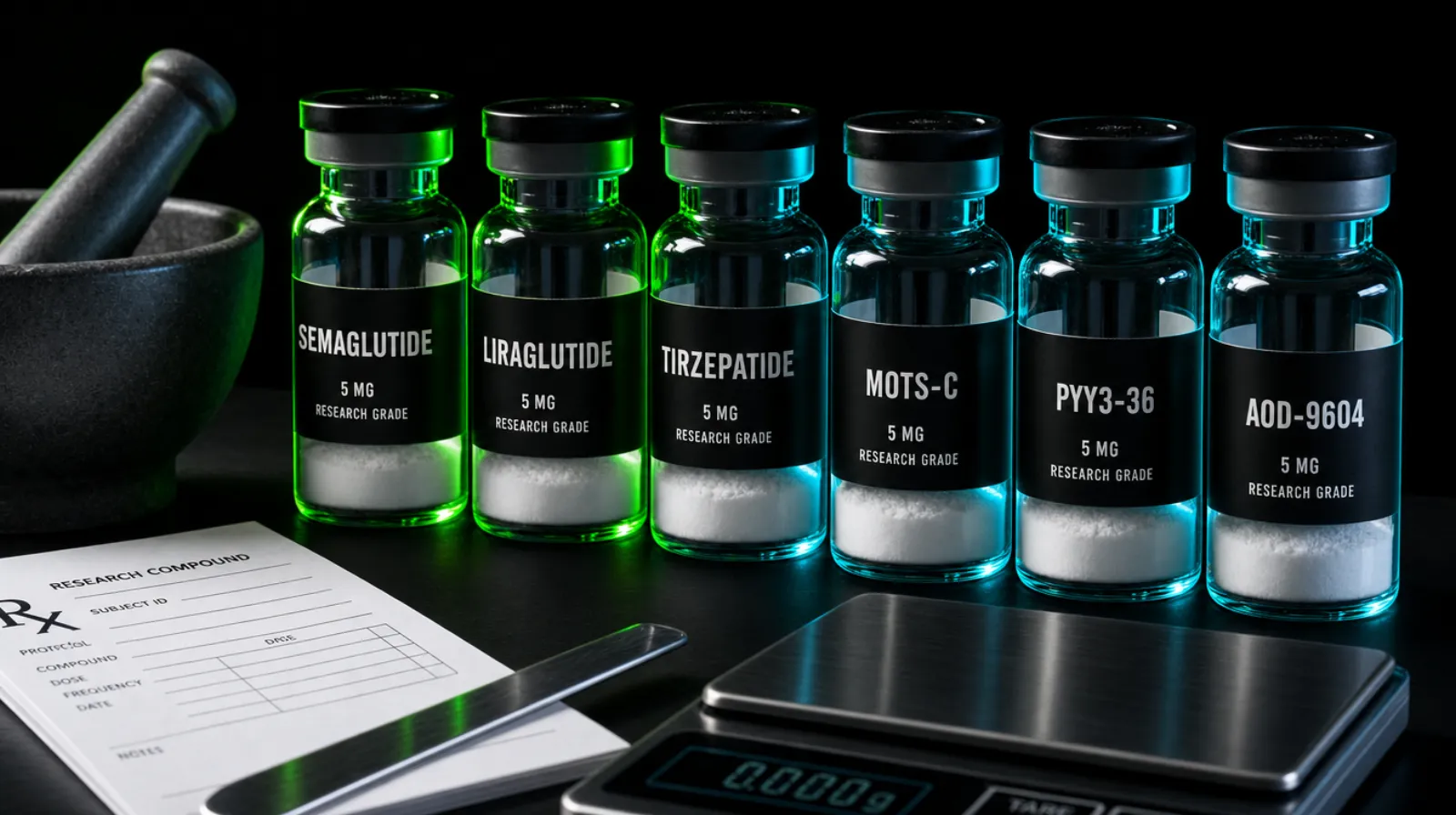
Peptides for weight loss are short chains of amino acids that change appetite or fuel use. Only one group has real human outcome data. That is the GLP-1 family: semaglutide, tirzepatide and retatrutide. They cut body weight by 12 to 20 percent in large trials. MOTS-c, PYY3-36 and AOD-9604 sit in animal work or a failed trial.
Spend time in gym forums and you'll meet half a dozen sold as the next shortcut. Some of that talk rests on real trial data. Most of it does not.
So I've sorted them by evidence, not by hype. What has been through large trials in people. What is still animal work. And what already failed.
One disclosure first. This article carries an affiliate relationship with a peptide research source. It doesn't change how the evidence is graded below.
Which are the best peptides for weight loss?
The GLP-1 class, its two-receptor cousin tirzepatide, and the triple agonist retatrutide. That is the whole list.
GLP-1 drugs have the deepest trial record of any weight-loss peptide. They work on three fronts. They blunt appetite. They slow how fast the stomach empties. And they change the fullness signal in the brain.
One review pooled 13 trials in obese adults without diabetes. Mean body weight fell by 12.79 percent. BMI fell by 4.80 kg/m². Waists shrank by nearly 10 cm on average (Mohamed 2025). A second review of the same drugs found the effect held up against placebo (Ahmad 2026).
The mechanism is not mysterious. A slower stomach blunts the hunger signal that would hit an hour or two after eating. A review a decade ago already called this class safer than the older diet drugs. That is much of why it became the default (Isaacs 2016).
Tirzepatide goes further. It hits two receptors, not one: GLP-1 and GIP. Switching on GIP makes fat cells break down and burn fat directly. So it stacks a second route on top of the appetite effect. A review of trials from 2020 through early 2025 found it scaled cleanly with dose (Kasagga 2025). Two routes beat one. That is the whole story behind its edge.
Retatrutide goes one further again. It is a triple agonist, hitting GIP, GLP-1 and glucagon receptors at once. In a Phase 2 trial of 338 adults, the highest dose cut body weight by 24.2 percent at 48 weeks. Placebo managed 2.1 percent (Jastreboff et al. 2023). Those are the largest reductions any weight-loss drug has posted. Read that with one caveat: this is Phase 2, not the large Phase 3 programmes behind semaglutide and tirzepatide. Gastrointestinal side effects were the most common, and they tracked the dose. We go deeper in our guides to retatrutide dosing and titration, retatrutide side effects, and retatrutide vs tirzepatide and semaglutide.
What does the peptides for weight loss evidence show?
Sorted by the strongest evidence each one actually has, the field gets small fast.
| Compound | Strongest evidence it has | What that means for you |
|---|---|---|
| Semaglutide, liraglutide | Large randomised trials in people | Proven human fat loss, with lean mass lost alongside it |
| Tirzepatide | Large randomised trials, dose-dependent | Outperforms single-pathway GLP-1 drugs on weight |
| Retatrutide | Phase 2 trial in people | Largest weight loss measured so far, on earlier-stage evidence |
| MOTS-c | Rodent studies only | Different mechanism, no human confirmation yet |
| PYY3-36 | Short human feeding studies | Real appetite effect, no workable dosing form |
| AOD-9604 | Failed its human trial | Animal data did not survive a placebo comparison |
Real-world use has caught up with the trial data too. Outside the trials, appetite and food intake still track how much drug is in the blood (Thomsen 2025). So the effect is not a trial quirk.
Are peptides safe for weight loss?
The proven ones are well tolerated. The unproven ones carry a different risk: nobody knows.
For the GLP-1 class, the safety record is why it became first-line. A review a decade back already rated it above the older diet drugs. The real cost is not a side effect people list. It is what comes off alongside the fat.
For everything else on the usual list, the honest answer is that safety has not been established in people at all. An animal study tells you a mechanism exists. It does not tell you what a year of use does to a person. Treat a compound with no human trial as an open question, not a safer option.
What peptides are good for weight loss and muscle gain?
None of them add muscle. That is the first thing to be clear about.
These drugs take fat first, but muscle goes with it. Muscle makes up roughly 20 to 30 percent of the weight you lose (Chrysavgis 2025). If you train, that is not a footnote. It is the gap between coming back leaner and coming back weaker.
The same review named the fix, and it is not another compound. Lift weights. Eat enough protein. The muscle loss is not fixed; it tracks what you do alongside the drug. For how growth-hormone peptides fit a body-composition plan, see our CJC-1295 and Ipamorelin guide.
Which ones are still animal data or a failed trial?
The peptides for weight loss evidence runs out here. The other three each fall down at a different point.
MOTS-c comes from the mitochondria, the cell's power plants. It switches on AMPK, the cell's fuel sensor. In rats it blocked weight gain and insulin resistance without touching appetite. That is a different lever from the GLP-1 drugs. It shifts which fuel the cell burns rather than turning hunger down. The catch is simple. It is all animal work. No human trial has confirmed it.
PYY3-36 is a gut hormone. It cuts food intake through the Y2 receptor in the brain. The single-dose results are striking. It cut food intake by 30 percent in obese subjects. In lean subjects it cut it by 31 percent (Karra 2009). Earlier rat work found branched forms also helped fat cells (Pedersen 2010). Cuts of roughly 30 to 33 percent last around 12 hours. The effect is real. It just does not last. It clears the body fast, so it never became a weekly product.
AOD-9604 is the clearest warning here. It is a fragment of growth hormone, amino acids 176 to 191. It cut fat mass across several rat studies. Then it reached a Phase 2b human trial. It failed to beat placebo on the main weight-loss measure, and never got approval. If a compound is sold on animal data while its failed human trial goes unmentioned, notice that.
Where is the best place to buy peptides online for weight loss?
Nowhere I would name as a single answer, and that is deliberate.
The batch matters as much as the molecule. A vendor's own certificate is a claim, not evidence, so check the lab behind it before you trust a number on the page. Our guide on how to read a peptide COA covers exactly what to look at.
Rather than point you at one seller, I keep a trusted, vendor-neutral sources page assessed against published testing criteria. Match the compound to the evidence you are happy with, not to whichever has the loudest marketing behind it.
Is there a new anti obesity peptide worth watching?
The ranking didn't move. The caveats did.
Nothing new has joined the top tier. What has moved is the muscle picture, and that changes how you train through a cut rather than what you take. An athlete managing body composition is in a different spot from someone chasing the newest animal-stage mechanism.
Related: Which Peptides Are Legal Again in 2026? The Full FDA List
Where to buy AOD-9604
If you're researching this compound, I've linked a trusted source below. It supports the channel.
See the sources that passed →Bibliography
- Jastreboff et al. 2023, Triple-Hormone-Receptor Agonist Retatrutide for Obesity: A Phase 2 Trial, PMID 37366315
- Ahmad et al. 2026, GLP-1 receptor agonists for weight loss: A systematic review and meta-analysis, PMC12991648
- Mohamed et al. 2025, GLP-1 Receptor Agonists in Obese Patients Without Diabetes, PMC12670982
- Thomsen et al. 2025, Real-world evidence on newer GLP-1RA-based weight-loss therapies, PMID 40196933
- Isaacs et al. 2016, Role of GLP-1 receptor agonists in management of obesity, PMID 27521241
- Kasagga et al. 2025, Dose-Dependent Efficacy and Safety of Tirzepatide, PMC12234836
- Karra et al. 2009, The role of peptide YY in appetite regulation and obesity, PMID 19064614
- Pedersen et al. 2010, N-terminally branched PYY3-36 isoforms, PMID 20853314
- Chrysavgis et al. 2025, GLP-1 Receptor Agonists and Body Composition, PMC12733374
This content is for educational purposes only. These compounds are intended for research use. Nothing here is medical advice. Always work with a qualified clinician before making changes to your health protocol.
Where to buy AOD-9604
If you're researching this compound, I've linked a trusted source below. It supports the channel.
See the sources that passed →Share this article
Frequently Asked Questions
What is the most clinically proven peptide for fat loss?
How do GLP-1 peptides cause fat loss?
Is MOTS-c effective for fat loss?
Why did AOD-9604 fail its clinical trial?
Do fat-loss peptides cause muscle loss?
What are the side effects of GLP-1 fat-loss peptides?
Read Next

Disclaimer: This content is for educational purposes only. These compounds are intended for research use. Nothing here is medical advice. Always work with a qualified clinician before making changes to your health protocol.