
AOD 9604 Peptide: Fat Metabolism, Evidence, Legality

What Is AOD 9604, and What Does AOD 9604 Do?
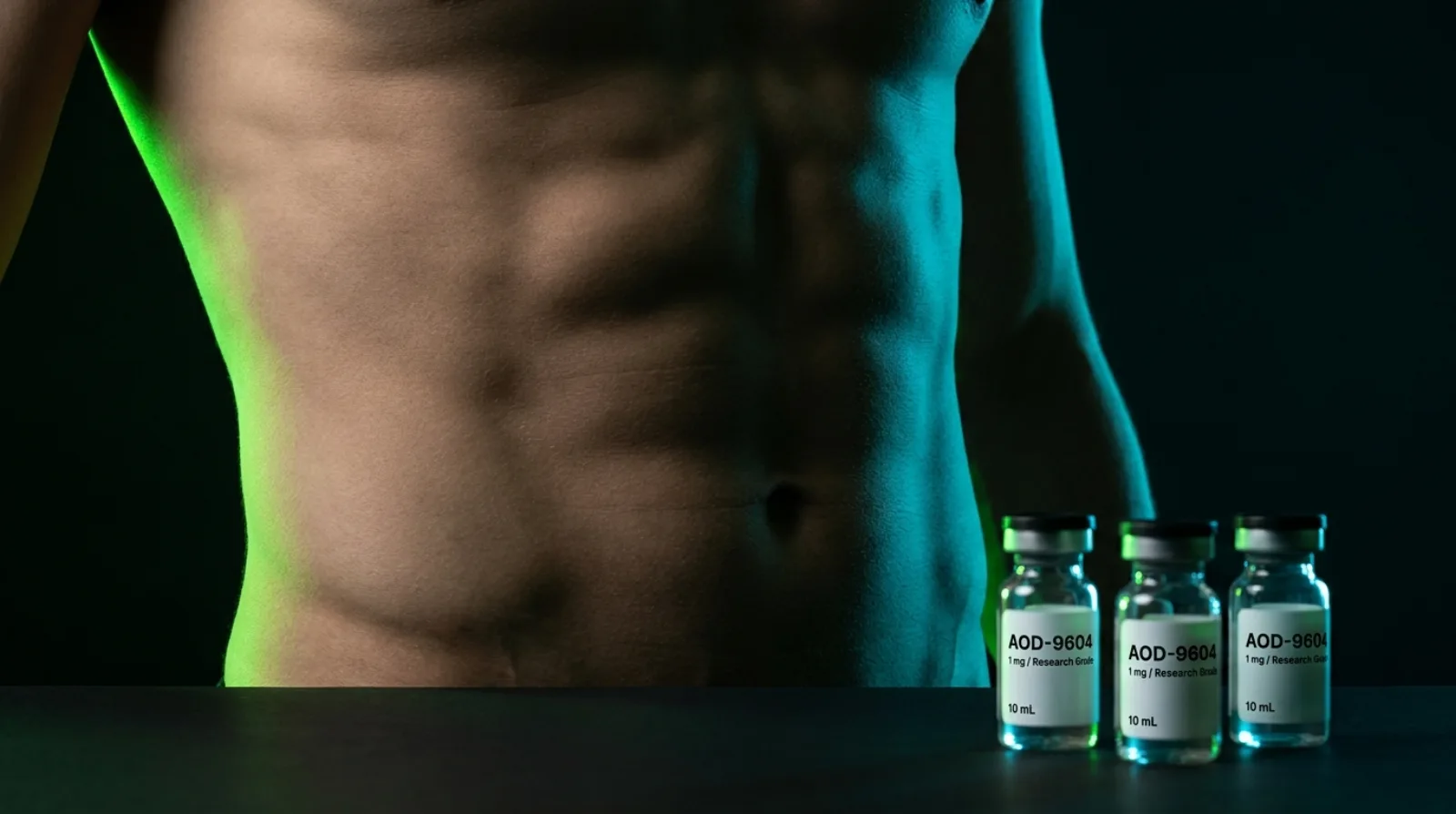
AOD 9604 peptide is a 15-amino acid piece of human growth hormone. It is the stretch known as residues 177 to 191. It was built to switch on fat burning through beta-3 adrenergic receptors in adipose tissue, the body fat. It does not bind growth hormone receptors. It does not raise IGF-1.
So it takes the fat-burning half of hGH and leaves the growth half behind.
Metabolic Pharmaceuticals Limited built it in Australia in the late 1990s. It was the first real try at cutting the fat signal out of growth hormone and selling it on its own. The logic was simple. Full hGH burns fat. It also raises IGF-1, speeds bone growth and worsens insulin sensitivity. Those effects make it a poor obesity drug. Isolate the C-terminal domain that drives fat oxidation and you might get a clean one.
That idea drove over a decade of research. It ran through three preclinical programmes and at least six randomised controlled trials. More than 900 human subjects took part. The compound reached Phase IIb. It was genuinely studied. Then the work stopped in 2007, for reasons that still matter to anyone weighing it up now.
This guide covers how it works, the human evidence, the rules, and where it sits in 2026.
How Does the AOD 9604 Peptide Work?
AOD 9604 binds beta-3 adrenergic receptors on adipocyte membranes, the outer skin of a fat cell. That binding raises cAMP inside the cell. cAMP switches on hormone-sensitive lipase. The lipase then splits stored triglycerides into free fatty acids. Those go into the blood to be burned. None of this touches growth hormone receptors, insulin signalling or IGF-1.
The contrast with full hGH is the whole point. Growth hormone binds the hGH receptor. It fires JAK2/STAT5 signalling. It drives IGF-1 in the liver. It speeds longitudinal bone growth, the growth in length. It also switches on lipolysis, the breakdown of fat, down a second path. The fat signal and the growth signal travel together. You cannot get one without the other.
The C-terminal fragment of hGH is residues 177 to 191. That is the exact stretch AOD 9604 copies. It keeps the fat signal. It lacks the structural epitopes, the binding shapes, needed to grip the hGH receptor. Heffernan et al. 2001 showed that split. In obese mouse models, AOD 9604 cut body weight gain. It raised fat oxidation. It drove lipolysis at rates like full hGH. And it showed no link to the growth hormone receptor at all.
Beta-3 receptors are packed tightly into visceral and brown adipose tissue. When one fires, cAMP rises. cAMP turns on protein kinase A. That turns on hormone-sensitive lipase. Endocrinology research shows one more thing. In obese models, beta-3 receptors are turned down, and AOD 9604 lifts them back to lean-control levels. So it may undo some of that shift, not just push past it.
Human studies report no change in insulin sensitivity. They report no change in glucose, no drop in appetite, no rise in thyroid hormone and no change in IGF-1. This is targeted in a way full hGH is not.
What Did the AOD 9604 Animal Studies Find?
In obese mice and rats, AOD 9604 cut body weight gain and raised fat oxidation. In Zucker rats, an oral dose cut body weight gain by more than 50 percent against controls. Blood glucose and insulin sensitivity were not harmed.
The first careful work came from Monash University with Metabolic Pharmaceuticals. Ng et al. 2000 gave oral AOD 9604 to obese Zucker rats. That strain is obese by birth. It is used as a stand-in for diet-driven obesity. Body weight gain fell by more than 50 percent against vehicle-treated controls. Lipolytic activity measured ex vivo, outside the body, was significantly elevated in the treated animals. Glucose and insulin were not harmed.
The Heffernan et al. 2001 ob/ob mouse study went further. It ran AOD 9604 head to head with full hGH. Both cut fat by about the same. Both drove lipolysis. Only hGH bound the receptor and raised IGF-1. That was the proof that earned the move to human trials.
Two caveats carry weight here. Obese rodents are poor stand-ins for human metabolic disease. The ob/ob mouse has no working leptin. The Zucker rat has a fault in its leptin receptor. Human obesity is polygenic, driven by many genes at once, and shaped by how we live. Neither rodent maps onto that. The dose-response in animals was also broadly linear. It did not predict what people would do. The animal work showed the mechanism. It did not show the size of the human effect.
What Are the AOD 9604 Benefits in the Human Trials?
The main trial ran 12 weeks. It enrolled 300 obese adults across six dose groups, from 0 to 30 mg daily. The 1 mg daily dose worked best. It gave 2.6 to 2.8 kg of weight loss against 0.8 kg on placebo. Bigger doses did less. That is an inverse dose-response, and it is odd, and nobody has fully explained it.
| Trial arm | Weight loss over 12 weeks | What the trial showed |
|---|---|---|
| Placebo | 0.8 kg | The comparison arm |
| 1 mg daily | 2.6 to 2.8 kg | The best result in the trial |
| 5 mg, 10 mg, 20 mg and 30 mg daily | Less than the 1 mg group | Benefit fell as the dose rose |
A PMC review of the trial data sums up the main finding. Subjects in the 1 mg/day arm lost 2.6 kg on average over 12 weeks. Placebo lost 0.8 kg. Reporting at the time of the Phase 2b release put the figure at 2.8 kg in the best dose group. That is more than triple the placebo loss.
What makes the trial odd is the missing dose-response curve. The 5 mg, 10 mg, 20 mg and 30 mg groups each lost less than the 1 mg group. Nobody has pinned down why. The ideas on offer include receptor downregulation, where the cell turns receptors down as more are filled. Or bell-curve kinetics at the beta-3 receptor. Or competitive partial agonism at higher doses, where the drug crowds its own site and works less. Whatever the cause, it wrecked the commercial path. You cannot scale an obesity drug when the best dose is 1 mg and bigger doses work worse.
The visceral fat finding is the more interesting one. The multicenter study measured fat loss by DEXA scan. Subjects given AOD 9604 lost visceral belly fat at rates 4.6 times higher than subcutaneous limb fat. Both arms ate to the same caloric restriction. Visceral adipose tissue is the fat depot that drives heart and metabolic risk. For men who carry it, that matters more than the number on the scale.
Why Was AOD 9604 Development Stopped in 2007?
Metabolic Pharmaceuticals Limited stopped the programme in 2007. Phase IIb trials showed the compound was safe. They did not show enough weight loss to win approval as a commercial obesity drug.
An NIH-indexed review of obesity pharmacotherapy backs that up. The drug did not show weight loss big enough to be commercially viable. Regulators want an anti-obesity drug to cut body weight by at least 5 percent from baseline over 52 weeks, in a good share of subjects. 2.6 to 2.8 kg over 12 weeks in a 300-person trial does not meet that bar. It meets it less still when the effect does not scale with the dose.
This is worth saying plainly. The compound is still talked about and sold in grey-market research settings as though the clinical failure were red tape. It was not. The signal in humans was real but clinically modest. The dose-response was paradoxical, working backwards from what you would expect. The company that owned and funded the research stopped it on scientific and commercial grounds.
No regulatory authority has approved AOD 9604 for weight loss or for anything else. That covers the FDA, the EMA and the MHRA. It covers the TGA too, Australia's Therapeutic Goods Administration, even though Australia is where the compound was built.
How Does AOD 9604 Compare With GLP-1 Agonists?
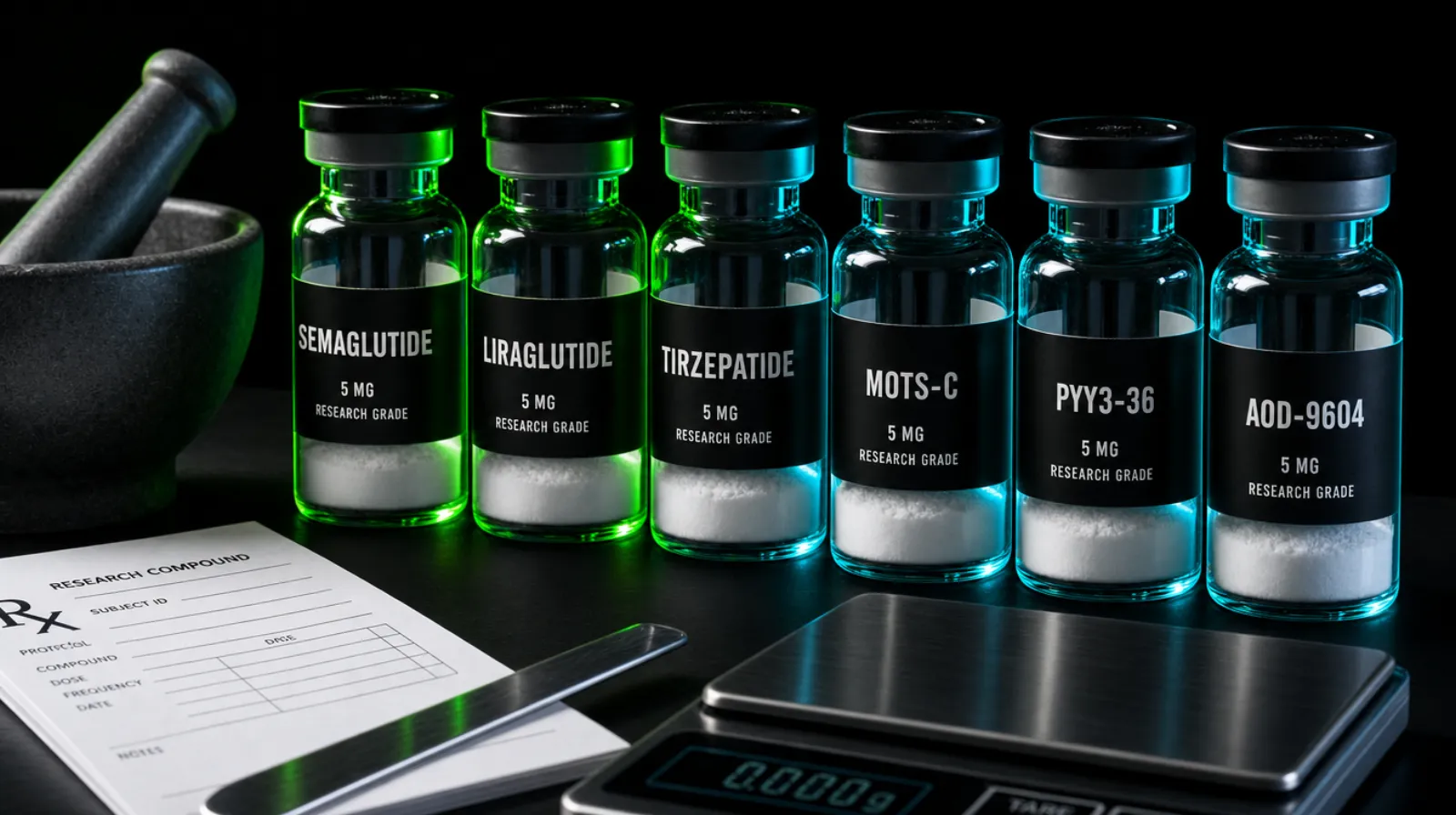
The two work down completely different paths. AOD 9604 switches on adipocyte lipolysis itself, through beta-3 adrenergic signalling out in the tissue. GLP-1 agonists such as semaglutide and tirzepatide cut intake instead. They work on satiety in the brain, and they slow gastric emptying, the rate food leaves the stomach. GLP-1s give 14 to 22 percent body weight loss in trials. AOD 9604 gave roughly 2 percent.
This matters. AOD 9604 is often sold in biohacking circles as a fat-loss peptide as good as GLP-1 drugs, or better. The evidence does not back that.
The split in mechanism is real and worth knowing. GLP-1 agonists do not switch on fat cell lipolysis. They cut caloric intake and slow gastric emptying. That leaves a caloric deficit, and the body covers part of it by burning fat. AOD 9604 does not suppress appetite at all. It acts on adipocytes whatever you eat. In theory, if both ran at full effect at once, they would be complementary rather than redundant.
The gap in practice is just as real. Semaglutide at 2.4 mg weekly cuts body weight by about 14 to 15 percent over 68 weeks in trials. Tirzepatide gets close to 20 to 22 percent. The best AOD 9604 result is about 2 percent over 12 weeks. It also has that odd dose ceiling, and we do not know how long the effect holds past the trial window.
One rationale still stands up. The visceral fat data is the most defensible reason to look at AOD 9604 at all. Visceral fat loss carries outsized metabolic benefit. And GLP-1s have not been specifically studied for visceral-preferential fat mobilisation in all populations. Our review of the fat-loss peptide research sets out how the wider field compares.
What Are the AOD 9604 Side Effects?
The safety record is the strongest part of the file. Safety data across the whole trial programme, reported across 900 plus participants, was clean.
The clinical review confirms no serious adverse events. It reports no glucose intolerance. No insulin resistance. No joint complications. No carpal tunnel syndrome. That is notable, because every one of those is a known problem with full hGH use. Human studies also report no drop in appetite, no rise in thyroid hormone and no change in IGF-1.
Safety was not why the programme stopped. Weak efficacy was. The trials ran 12 weeks, and nothing tells us how the effect holds past that window.
Is AOD 9604 Legal to Buy?
AOD 9604 has no approved use anywhere in the world. It is not FDA-approved, EMA-approved, TGA-approved or MHRA-listed. It exists only as a research compound. Some countries allow it for scientific study. There is no licensed clinical supply pathway for weight loss or obesity treatment.
The TGA approval question comes up again and again. Metabolic Pharmaceuticals was an Australian firm. Some sources read early Australian regulatory contact as proof of approval. That is wrong. The compound entered clinical development inside Australia's rules. It was never granted a Therapeutic Goods Administration product licence. The work stopped before it reached registration.
WADA status matters for tested athletes, who may meet AOD 9604 in supplements. Growth hormone fragments are named on the WADA Prohibited List. They sit under peptide hormones, growth factors, and related substances. Any athlete subject to testing should treat AOD 9604 as banned. Our overview of peptide legality in 2026 covers the wider rules.
In research settings the position is simpler. It is a well-studied peptide with published synthesis routes and known purity standards. It is sold as a research-grade compound in places where research use of unlicensed biologics is allowed under proper oversight.
How Much AOD 9604 Peptide Did the Research Use?
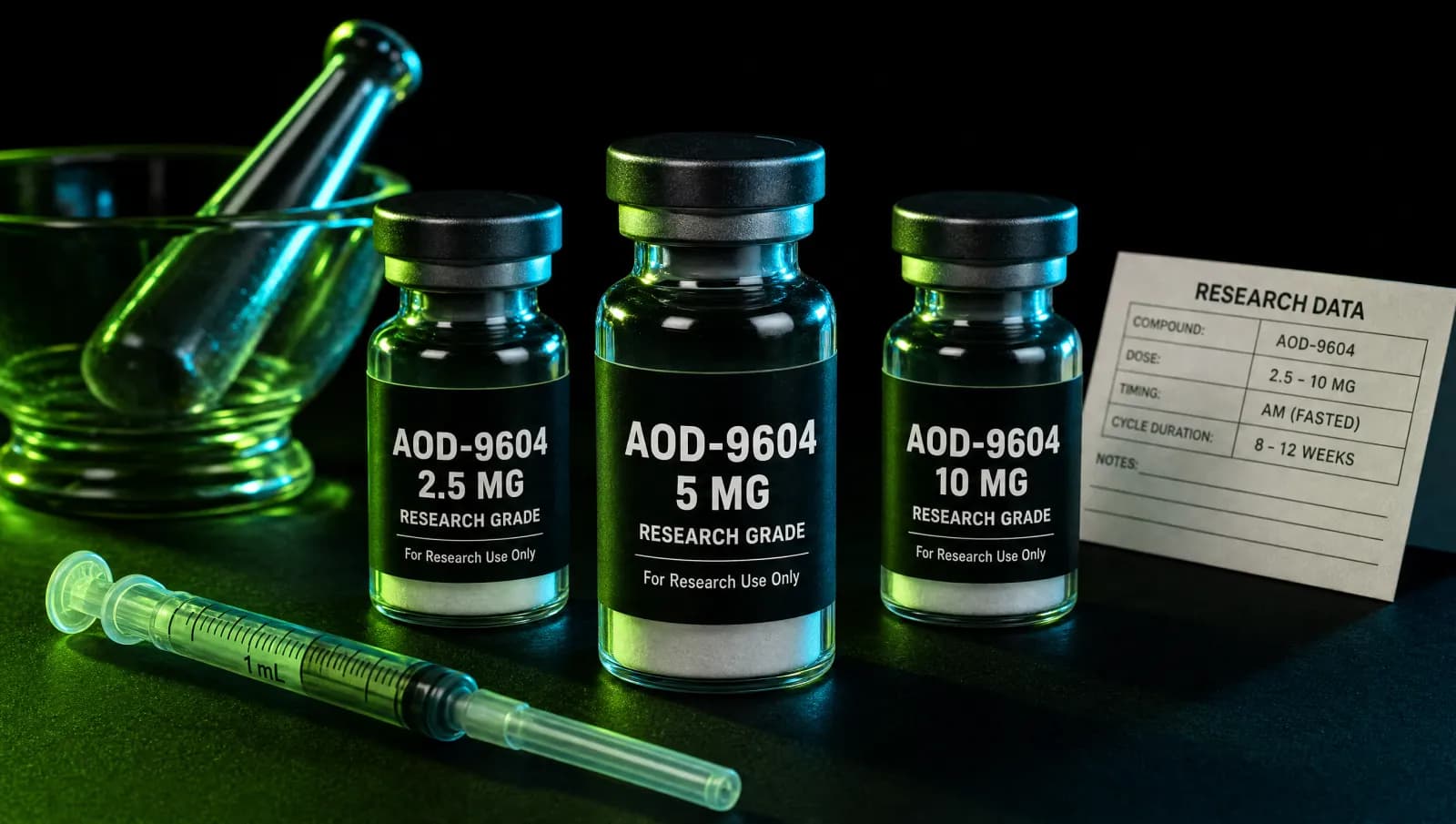
Published human trial data used 1 mg daily as the best oral dose. Research work tends to use subcutaneous injection at 250 to 500 micrograms per day. That figure is read across from the preclinical parenteral dosing literature, the studies that injected rather than fed. There is no set best human research dose for subcutaneous use. The oral Phase IIb dose does not convert straight to an injected one.
The dosing picture is genuinely murky. The clinical trials used oral delivery. The compound has fair oral bioavailability, which is unusual for a peptide. Most research work now uses subcutaneous injection instead. The two routes cannot be swapped without pharmacokinetic data, and that data is not in the public literature.
The preclinical side is clearer. Effective doses in animal studies ran from 250 to 500 micrograms per kilogram body weight, given under the skin. Reading that straight across to human research doses is hard. The obese rodent problems above apply. Metabolic rate also scales differently between species.
Reconstitution follows standard research peptide protocol. Use bacteriostatic water. Store it cold, at 2 to 8 degrees Celsius. Use it within 28 days of reconstitution. Keep standard aseptic technique. Lyophilised AOD 9604, the freeze-dried powder, is stable at room temperature before you mix it. Once in solution it degrades fast if it is not kept cold.
Always work with a qualified clinician before making changes to your health protocol. Peptide dosing needs your own context. Published research doses are not prescriptions. Our AOD-9604 dosage and cycling guide goes deeper on injection timing and maintenance.
Is AOD 9604 Stacked With Other Peptides?
It is, in research settings. But no combination clinical data exists.
The mechanism is direct adipocyte lipolysis through beta-3 adrenergic activation, with no appetite or hormonal effects. In theory that makes it complementary to compounds that cut intake or work on the growth hormone axis. Every stacking use is guesswork drawn from mechanism.
The logic for pairing it with GH secretagogues such as ipamorelin or CJC-1295 runs like this. Secretagogues raise endogenous GH pulses, the body's own bursts, and those drive their own fat breakdown. AOD 9604 acts on fat cells itself, outside the GH axis. Whether the two add up, multiply or just overlap is unknown. No human data exists on the pairing.
Some researchers pair AOD 9604 with caloric protocols aimed at visceral fat, given the DEXA data. The 4.6x visceral to subcutaneous fat loss ratio from the multicenter trial hints at something. It suggests the compound may matter more for metabolic risk than for gross scale weight. Visceral fat predicts heart and insulin resistance outcomes. That reframing is worth building into any research design. For more on how growth hormone fragments compare and stack, see our AOD-9604 fat loss overview.
What Do AOD 9604 Before and After Claims Really Show?
Less than the marketing implies.
The best published trial result was roughly 2 percent of body weight over 12 weeks. Before and after claims that imply more are running ahead of the data.
What AOD 9604 is not, despite how it is frequently marketed: a weight-loss agent as good as approved pharmacotherapy. Or a proven body composition tool where more dose means more result. Or a compound with any approved use pathway in 2026.
The clinical programme was real. The safety data is genuinely reassuring. The visceral fat biology is interesting. The efficacy gap against modern anti-obesity drugs is just as real.
Where to buy AOD-9604
Research-grade AOD-9604 verified by third-party HPLC testing. See our recommended sources for current vetted suppliers.
See the sources that passed →Where Can You Buy AOD 9604 Peptide Safely?
With AOD 9604, the supplier matters as much as the dose. We only list sources that publish an independent, per-batch certificate of analysis. See the ones that clear it.
Who Is Researching AOD 9604 in 2026, and Why?
In 2026, AOD 9604 sits in a small research niche. Three things keep it there. A clean safety profile across 900-plus human subjects. Measured visceral fat selectivity. And a mechanism unlike both full hGH and GLP-1 agonists. It is not a first-choice fat-loss tool in any set protocol.
The real uses are narrow. First, anyone studying beta-3 adrenergic receptor biology in human adipose tissue has a well-studied agonist with a clean human safety record. Second, anyone aiming at visceral fat as a metabolic health target, rather than gross weight loss, has DEXA-measured selectivity data to work from. Third, anyone studying hGH fragment pharmacology apart from IGF-1 gets an isolation full hGH cannot give.
Men in the 35-plus demographic weighing AOD 9604 for research should read the Phase IIb data clear-eyed. It shows a statistically significant but clinically modest effect. It shows an unexplained inverse dose-response. And it shows a safety record that holds up across hundreds of subjects. That is more than most grey-market research compounds can claim. It is also far less than the current standard of care for metabolic disease.
References
- Heffernan et al. 2001 - Increase of fat oxidation and weight loss in obese mice caused by chronic treatment with human growth hormone or a modified C-terminal fragment. Int J Obes Relat Metab Disord.
- Ng et al. 2000 - Metabolic studies of a synthetic lipolytic domain (AOD9604) of human growth hormone. Horm Res.
- - Central and Peripheral Molecular Targets for Anti-Obesity Pharmacotherapy.
- - Obesity Pharmacotherapy: Current Perspectives and Future Directions.
- - Endocrinology research on beta-3 adrenergic receptor modulation in adipose tissue.
- News-Medical 2004 - Obesity drug codenamed AOD9604 highly successful in trials.
- ResearchGate 2005 - The effect of AOD9604 on weight loss in obese adults: Randomized double-blind placebo-controlled multicenter study.
- Oxford Scientist 2025 - Investigating the Research Potential of the Peptide AOD-9604.
This content is for educational purposes only. These compounds are intended for research use. Nothing here is medical advice. Always work with a qualified clinician before making changes to your health protocol.
Related: AOD-9604 Dosage and Cycling: Injection Timing, Fasted Cardio Stack, and Maintenance (2026)
Where to buy AOD-9604
Research-grade AOD-9604 verified by third-party HPLC testing. See our recommended sources for current vetted suppliers.
See the sources that passed →Share this article
Frequently Asked Questions
What is AOD 9604 peptide, and how is it different from growth hormone?
What does the clinical evidence show for AOD 9604 and weight loss?
Does AOD 9604 work differently from GLP-1 drugs?
Is AOD 9604 legal, and what is its status in 2026?
Does AOD 9604 target visceral fat?
What are the AOD 9604 side effects?
Read Next
Disclaimer: This content is for educational purposes only. These compounds are intended for research use. Nothing here is medical advice. Always work with a qualified clinician before making changes to your health protocol.