
Tesamorelin: Benefits, Side Effects, Evidence and Safety

What Is Tesamorelin, and What Does Tesamorelin Do?
Tesamorelin is a lab-made copy of growth hormone-releasing hormone (GHRH), the signal that tells the pituitary gland to release growth hormone. It holds FDA approval as Egrifta for HIV-linked belly fat. It carries the strongest trial evidence of any GHRH peptide now in use.
Most research peptides sit on a thin pile of animal work. Tesamorelin does not. It has been through two large Phase III trials in people. Phase III trials are the large, late-stage tests run before approval. A pooled analysis covered 806 patients. The FDA updated its label again in 2025.
That does not make it a free pass. It does mean the evidence here is a different kind of evidence. Sermorelin and CJC-1295 have nothing close to it.
This guide covers the mechanism, the trial results, the honest limits, the safety profile, the law and the sourcing bar. Each section points to a deeper article where one exists.
Affiliate disclosure: Underground Biohacking may receive a commission if you purchase through links on this page. This does not affect editorial independence. Vendor recommendations are based on third-party testing standards. See our recommended sources page for the full vetting criteria.
How Does the Tesamorelin Peptide Work in the Body?
Tesamorelin binds GHRH receptors on somatotroph cells at the front of the pituitary. Somatotrophs are the cells that make growth hormone. That binding switches on the Gs-protein and cAMP cascade inside the cell. The Gs-protein is a switch that passes the signal inward. cAMP is a small messenger inside the cell. Growth hormone then leaves in pulses, the way the body normally sends it.
The molecule is a 44-amino-acid copy of the body's own GHRH. One end carries an added trans-3-hexenoic acid group. That small cap shields it from dipeptidyl peptidase IV, an enzyme that chews up the natural hormone. So it lasts longer in the blood than native GHRH does (NCBI Bookshelf 2018).
The chain of events is short. Tesamorelin binds the receptor. Adenylate cyclase, the enzyme that makes cAMP, switches on. The level of cAMP inside the cell rises. Growth hormone is made and released in pulses. The liver answers by making insulin-like growth factor-1 (IGF-1). IGF-1 then drives the metabolic effects, including fat release from deep abdominal stores (NCBI Bookshelf 2018).
Here is the part that matters most. The pituitary keeps its own brake, a feedback signal called somatostatin. Injected growth hormone does not go through the pituitary, so that brake does not apply to it.
Healthy men took 2 mg under the skin daily for two weeks. Mean overnight growth hormone rose (p=0.004). Pulse size rose (p=0.001). IGF-1 rose by 181 µg/L (p<0.0001). Insulin-driven glucose uptake did not move (p=0.61) (Stanley 2011). µg/L means micrograms per litre. A p-value is the chance of seeing a result this large if there were no real effect. Smaller is stronger.
GHRH receptors also sit outside the pituitary. That hints at local roles in metabolism and tissue control that nobody has mapped yet.
What Do the Tesamorelin Trials Actually Show?
Strong results in one group of patients. Much thinner evidence everywhere else.
Two pivotal Phase III trials enrolled 806 HIV-infected patients with excess abdominal fat. Tesamorelin 2 mg daily cut visceral adipose tissue, the deep fat around the organs, by 15.4% against placebo at 26 weeks (p<0.001). Triglycerides and the ratio of total cholesterol to HDL cholesterol fell alongside it (Falutz 2010). Triglycerides are a type of fat in the blood. HDL is often called good cholesterol.
A 404-patient trial in the same population also reported its own results. At 26 weeks, visceral fat fell 10.9% on tesamorelin against 0.6% on placebo. Patients who stayed on tesamorelin for 12 months were down about 18%. Body image distress improved. Glucose measures did not change (Falutz 2010b).
A meta-analysis of five randomised trials backed that picture up. A meta-analysis pools the results of several trials. Visceral fat fell by a mean of 27.71 cm² (p<0.001). Lean body mass, everything that is not fat, rose. IGF-1 rose. The authors concluded this came without serious side effects or a change in glucose (Badran et al. 2026).
One detail gets missed. Tesamorelin strips deep visceral fat and largely leaves the fat under the skin alone (Falutz 2010). If surface body fat is the goal, this is the wrong tool. For visceral fat, nothing else in the peptide space carries this much evidence.
Off-label interest runs to visceral fat in people without HIV, to fatty liver disease, and to general growth hormone support. The mechanism makes that plausible. The randomised evidence does not yet cover it. A 12-week trial ran in 53 patients with type 2 diabetes. It found no difference in insulin response or fasting glucose against placebo. HbA1c changed differently from placebo in the 2 mg group at week 12. HbA1c is a blood test of average blood sugar over about three months (Clemmons et al. 2017).
Tesamorelin has also been studied for liver fat in HIV-positive people with fatty liver disease (Stanley 2021).
The honest position is this. The mechanism supports wider use. Formal safety data run to 52 weeks. But the Phase III numbers belong to HIV patients. Applying them to a healthy man in his forties is an inference, not a trial result.
What Are the Main Tesamorelin Benefits?
The approved benefit is narrow. It is less visceral abdominal fat in HIV-associated lipodystrophy, an abnormal spread of body fat. Off-label, clinicians and researchers reach for it to cut visceral fat and to lift growth hormone and IGF-1. They also use it to improve body composition. And they use it to support metabolic and liver health in adults carrying deep abdominal fat.
- Visceral fat loss. The strongest evidence on the page. It hits deep abdominal fat and mostly spares the fat under the skin.
- Growth hormone and IGF-1 support. It raises the body's own growth hormone release, both in pulses and at baseline, and it raises IGF-1 (Stanley 2011). No growth hormone is injected.
- Body composition. Pooled trial data shows lean body mass rising while visceral fat falls.
- Liver markers. Cutting visceral fat tracked with better liver enzymes in patients who started with raised ones (Fourman et al. 2017). It has also been studied in people with HIV and fatty liver disease (Stanley 2021).
- Immune signals, early days. A 12-month randomised trial found lower markers of cytotoxic T-cell and monocyte activity (Stanley 2021). Cytotoxic T-cells and monocytes are two kinds of white blood cell. That points to effects beyond metabolism.
Does Tesamorelin Help Build Muscle?
Not in the way that question usually means. Pooled trial data does show lean body mass going up while visceral fat comes down. Lean mass is everything that is not fat, so water and organ tissue count inside it too.
The people in those trials were HIV patients with excess abdominal fat. They were not trained men chasing size. No trial has put tesamorelin next to a training programme in healthy adults. The recomposition signal is real in the data and untested in the gym.
What Does Tesamorelin Before and After Really Look Like?
Deep fat, not the mirror.
The trials measured visceral adipose tissue directly. That is the fat packed around the organs, behind the abdominal wall. In the pooled Phase III analysis it fell 15.4% more than on placebo at 26 weeks (Falutz 2010). In the 404-patient trial it fell 10.9% at 26 weeks, against 0.6% on placebo. Patients who stayed on tesamorelin for 12 months were down about 18% (Falutz 2010b).
Fat under the skin barely moved in the same trials. So a photograph may show far less than the scan does. The change happens where a camera cannot reach.
Timing matters as well. Trials ran 26 weeks before the main readout. And the effect reverses. In patients switched to placebo, the visceral fat reduction was rapidly lost (Falutz 2010b).
How Much Tesamorelin Do the Approved Labels Use?
The FDA-approved dose is 2 mg under the skin once daily for Egrifta SV. Egrifta WR uses 1.28 mg under the skin once daily. Both go into the abdomen, with the site moved each time.
The two approved forms differ in how they are mixed, not in what they do:
| Form | Dose | What is different |
|---|---|---|
| Egrifta SV | 2 mg under the skin, once daily | Mixed fresh each day. The original clinical trial dose. |
| Egrifta WR | 1.28 mg under the skin, once daily | Mixed once a week. Prescribing label updated in 2025. |
The label says to rotate sites. It says not to inject into scar tissue, bruises or the navel (FDA 2025).
The label says to consider stopping treatment when IGF-1 stays high (for example above 3 SDS), especially if the fat response is weak (FDA 2025). SDS means standard deviation score: how far a level sits from the healthy average.
Treatment in the trials ran 26 to 52 weeks. Safety past 52 weeks has never been formally established (Spooner and Olin 2012).
The full protocol, the reconstitution method, the IGF-1 monitoring schedule and the injection technique sit in the dedicated tesamorelin dosing guide.
A qualified clinician can advise on any health decision.
What Are the Tesamorelin Side Effects?
Most of what shows up is mild. Injection-site reactions and joint pain lead the list. Serious adverse events hit fewer than 4% of patients over 26 weeks (Dhillon 2011). Three things deserve real attention: blood sugar, antibodies, and what nobody has measured past a year.
- Injection-site reactions (redness, itching, pain, hives): 17% of treated patients against 6% on placebo in the label's 26-week table. The label's warnings section gives a separate figure of 25% against 14% for injection site reactions over the first 26 weeks (FDA 2025).
- Arthralgia (joint pain): 13% against 11% on placebo (FDA 2025). It is among the events known to come with growth hormone therapy (Dhillon 2011).
- Peripheral oedema and myalgia (swelling in the limbs, and muscle aches): 6% each against 2% on placebo. The label ties this swelling to fluid retention from raised growth hormone. It says these fluid-retention effects are either transient or resolve when treatment stops (FDA 2025).
Growth hormone can push blood sugar up at pharmacological doses, meaning treatment doses above the body's natural levels. For tesamorelin, the data is mixed. Insulin-driven glucose uptake held steady in healthy men (p=0.61) while IGF-1 rose (Stanley 2011). In patients with type 2 diabetes, 12 weeks of 1 to 2 mg was tested against placebo. Insulin response and fasting glucose did not differ from placebo. HbA1c fell by 0.5% on placebo but rose by 0.1% on 2 mg. The authors report the difference as statistically significant at week 12 (Clemmons et al. 2017). In the label's trial data, 5% of treated patients reached an HbA1c of 6.5% or more by week 26, against 1% on placebo. The label says to check glucose before starting and to monitor it during treatment (FDA 2025).
In the trials, 50% of patients grew anti-tesamorelin IgG antibodies by 26 weeks. IgG is the most common type of antibody in the blood. About 60% of those also reacted to the body's own GHRH. Among patients with hypersensitivity reactions, 85% had the antibodies. With or without the antibodies, patients lost similar visceral fat and had similar IGF-1 rises. Allergy-type reactions, called hypersensitivity, hit 4% of treated patients (FDA 2025).
Stopping reverses the effects. In patients switched to placebo, the visceral fat reduction was rapidly lost (Falutz 2010b).
The gap in the record is time. No randomised trial has followed people past 52 weeks (Spooner and Olin 2012). IGF-1 is a growth signal, and holding it high raises a theoretical worry about feeding tumours. That worry is sharpest in anyone with a past cancer. Active cancer is an absolute stop. The label says to monitor IGF-1 levels during treatment, and that the effects of long-raised IGF-1 are unknown (FDA 2025).
Who Should Not Use Tesamorelin?
Some of these are hard stops. They come off the FDA label and out of the pharmacology, not from caution for its own sake.
The 2025 FDA label says tesamorelin must not be used in these cases. The label calls them contraindications.
- A damaged pituitary system. The label names pituitary removal, an underactive pituitary, a pituitary tumour or surgery, head radiation and head injury.
- Active cancer (malignancy). The label says any past cancer should be inactive, with treatment done, before starting.
- A known allergy (hypersensitivity) to tesamorelin or the other ingredients.
- Pregnancy (FDA 2025).
The next groups are not absolute bars. They are reasons to go ahead only with monitoring:
- Type 2 diabetes or pre-diabetes. The label calls for glucose checks before and during treatment. The drug raises IGF-1. So the label also calls for regular checks in people with diabetes for new or worse retinopathy, a form of eye damage (FDA 2025).
- A prior cancer, because of the theoretical IGF-1 growth risk.
- Cardiovascular disease, because growth hormone and IGF-1 act on the heart and vessels in complicated ways.
- Anyone already taking growth hormone at pharmacological doses.
A qualified clinician can advise on any health decision.
Is Tesamorelin Legal to Buy?
It is legal on prescription. It is not legal to sell for human use as a research chemical. Those two sentences describe two different products.
The approval history is short:
- November 2010: the FDA approved the original Egrifta, the 2 mg form, for HIV lipodystrophy (Traynor 2010).
- 2025: an updated label landed for Egrifta WR, the 1.28 mg weekly-reconstitution form. It kept the same HIV lipodystrophy indication (FDA 2025).
For the approved use, a licensed clinician can prescribe it and the whole thing is legal. Off-label use in people without HIV is not FDA-approved. It still sits inside legal medical discretion in the United States when a clinician prescribes it.
Research-grade tesamorelin from unregulated peptide sellers is a different category. It is labelled for research use only. It is not legally approved for human administration.
That regulatory gap is the real separator. Sermorelin is compounded, with no current FDA approval for any indication. Compounded means made to order by a pharmacy, not by a drug company. CJC-1295 has no FDA approval at all. Tesamorelin has a live approval pathway for the right patient.
How Does Tesamorelin Compare With Other GH Peptides?
No other growth hormone peptide holds an active FDA approval backed by Phase III trials. That is the headline difference. The mechanisms differ too, and that changes what each one is good for.
Sermorelin is the short 1-29 fragment of natural GHRH. Tesamorelin is the full 44-amino-acid version with a stabilising cap, so enzymes break it down more slowly. Tesamorelin carries far more trial evidence. Sermorelin has the longer off-label history and is easier to get from compounding pharmacies. The full breakdown sits in the tesamorelin and sermorelin comparison.
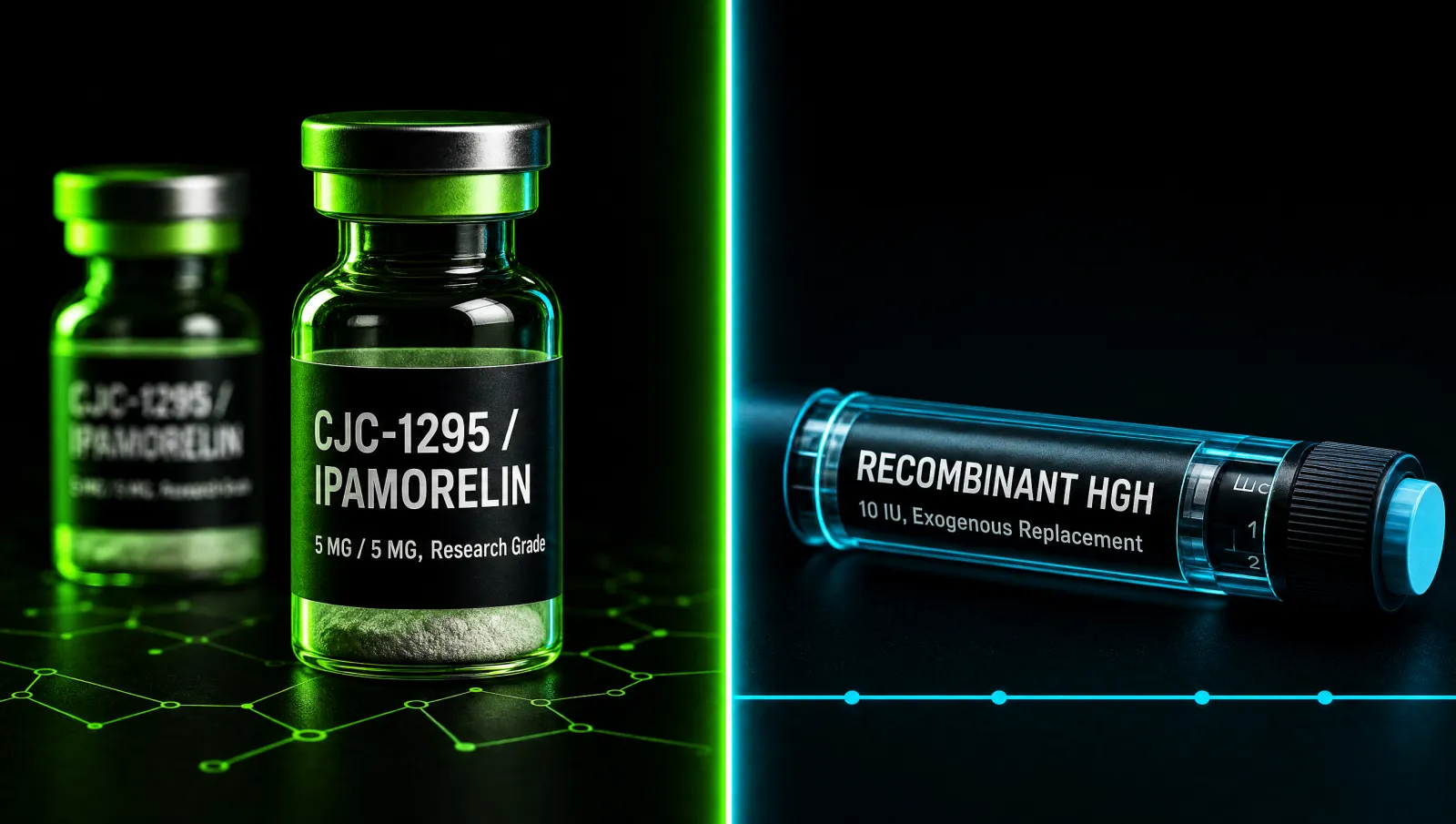
CJC-1295 is a long-acting GHRH analogue that grips albumin, a blood protein, to stay around longer. An analogue is a lab-made variant of a natural molecule. It holds no FDA approval and no Phase III evidence. More on that in the CJC-1295 guide.
Ipamorelin is not a GHRH analogue at all. It is a ghrelin receptor agonist, working through a separate receptor system. That means it switches on the ghrelin receptor rather than the GHRH receptor. Both end up raising growth hormone by different routes, which is why some clinicians pair them. Tesamorelin has the stronger visceral fat data. Ipamorelin is valued for clean growth hormone release with little effect on cortisol, a stress hormone, or prolactin, a hormone that drives milk production. See the tesamorelin and ipamorelin comparison.
Injected growth hormone is the comparison that explains the niche. It bypasses the pituitary and winds down natural output over time. Pharmacological doses bring insulin resistance, acromegalic changes and fluid retention. Acromegalic changes are the large hands, feet and face seen with too much growth hormone. Held-up IGF-1 also carries a carcinogenic (cancer-causing) worry. Tesamorelin works one step upstream. In healthy men, it raised both pulsed and baseline growth hormone release. In healthy men, 2 mg daily raised IGF-1 while insulin-driven glucose uptake held steady.
Where Can You Buy the Tesamorelin Peptide Safely?
Quality checking is not optional for anything bought outside the pharmacy route.
The prescription route answers the question by itself. Egrifta is made under FDA oversight to pharmaceutical standards. For research-grade tesamorelin from grey-market sellers, the buyer carries the whole burden of proof.
The usual quality documents for a research peptide are these:
- An HPLC purity report. HPLC is a lab test that splits a sample into its parts to check how pure it is. >98% purity is the floor for a credible supplier.
- Mass spectrometry that confirms the molecular weight. Mass spectrometry is a lab test that weighs molecules. It has to match tesamorelin at 5135.9 Da, for the modified 44-amino-acid analogue. Da (daltons) is the unit for molecular weight.
- An endotoxin (LAL) testing certificate. Endotoxins are toxins from the outer wall of certain bacteria. LAL is the standard lab test for them.
- A certificate of analysis issued by an independent lab, not the seller's own bench.
- A batch-specific certificate that matches the vial that arrives.
A supplier who cannot produce current third-party certificates fails that basic bar. Reading one properly is its own skill, and it is covered in this guide to spotting real peptides.
Where to buy Tesamorelin
Research-grade tesamorelin is available from third-party-tested suppliers. Verify current COAs before purchasing. See our recommended sources page for vetted options.
See the sources that passed →References
- Falutz J, et al. (2010). Effects of tesamorelin, a growth hormone-releasing factor, in HIV-infected patients with abdominal fat accumulation: a randomized placebo-controlled trial with a safety extension. J Acquir Immune Defic Syndr. 53(3):311-22.
- Falutz J, et al. (2010). Effects of tesamorelin (TH9507), a growth hormone-releasing factor analog, in human immunodeficiency virus-infected patients with excess abdominal fat: a pooled analysis of two multicenter, double-blind placebo-controlled phase 3 trials with safety extension data. J Clin Endocrinol Metab. 95(9):4291-304.
- Stanley TL, et al. (2011). Effects of a growth hormone-releasing hormone analog on endogenous GH pulsatility and insulin sensitivity in healthy men. J Clin Endocrinol Metab. 96(1):150-8.
- NCBI Bookshelf (2018). Tesamorelin. LiverTox: Clinical and Research Information on Drug-Induced Liver Injury. NIH.
- FDA (2025). EGRIFTA WR (tesamorelin) Full Prescribing Information.
- Badran AS, et al. (2026). Body composition, hepatic fat, metabolic, and safety outcomes of Tesamorelin, a GHRH analogue, in HIV-associated lipodystrophy: a meta-analysis of randomized controlled trials. Obes Res Clin Pract. 20(1):2-12.
- Dhillon S (2011). Spotlight on tesamorelin in HIV-associated lipodystrophy. BioDrugs. 25(6):405-8.
- Clemmons DR, et al. (2017). Safety and metabolic effects of tesamorelin, a growth hormone-releasing factor analogue, in patients with type 2 diabetes: a randomized, placebo-controlled trial. PLoS One. 12(6):e0179538.
- Stanley TL, et al. (2021). Growth hormone releasing hormone reduces circulating markers of immune activation in parallel with effects on hepatic immune pathways in individuals with HIV-infection and nonalcoholic fatty liver disease. Clin Infect Dis. 73(4):621-630.
- Fourman LT, et al. (2017). Visceral fat reduction with tesamorelin is associated with improved liver enzymes in HIV. AIDS. 31(16):2253-2259.
- Spooner LM, Olin JL (2012). Tesamorelin: a growth hormone-releasing factor analogue for HIV-associated lipodystrophy. Ann Pharmacother. 46(2):240-7.
- Traynor K (2010). FDA approves tesamorelin for HIV-related lipodystrophy. Am J Health Syst Pharm. 67(24):2082.
This content is for educational purposes only. These compounds are intended for research use. Nothing here is medical advice. A qualified clinician can advise on any health decision.
Where to buy Tesamorelin
Research-grade tesamorelin is available from third-party-tested suppliers. Verify current COAs before purchasing. See our recommended sources page for vetted options.
See the sources that passed →Share this article
Frequently Asked Questions
Is tesamorelin legal?
Does tesamorelin work for visceral belly fat?
How is tesamorelin different from growth hormone (HGH)?
What is the typical tesamorelin dose?
What are the main side effects of tesamorelin?
When should I involve a clinician before using tesamorelin?
Read Next

Disclaimer: This content is for educational purposes only. These compounds are intended for research use. Nothing here is medical advice. Always work with a qualified clinician before making changes to your health protocol.